Affordable geoeconomics

If you choose industrial policies, buy ones you can afford

Even by the standards of the Trump Administration, which has gone nary a week without outraging someone with a new policy, last week’s announced deal with NVIDIA and AMD drew unusually broad opprobrium. The deal, in which the chipmakers receive export licenses to China for some of their most advance chips in exchange for 15% of the revenue from those sales,11 was called an “export tax,” “corporate extortion,” and “state capitalism with American characteristics.”22 It seems the only people to defend the deal were its participants, with NVIDIA stating “America cannot repeat 5G and lose telecommunication leadership.”33

And me. When I saw reports of the deal, my immediate thought was “Clever! I wish I’d thought of that.” My reasons differ from NVIDIA’s and perhaps the Trump Administration, but, like many Trump Administration economic and foreign policies, the deal makes geoeconomic sense to me.

“Sense? Seriously, Marvin?! And what is this geoeconomics of which you speak?”

Let me explain.

What is geoeconomics aka economic statecraft?

Geoeconomics, or as it is sometimes called, economic statecraft, is the use of economic policy to align other nations’ behaviors with your own interests, or to deter or degrade their ability to make war on you. Perhaps more accurately, albeit provocatively, one can think of it as economic warfare. The Prussian war theorist Carl von Clausowitz defined war as diplomacy by other means and economic statecraft is one of several non-kinetic (non-lethal) means of coercing other nations to a desired path when asking nicely doesn’t work.44

Nothing new under the sun

While many economists, commentators and politicians have deemed economic statecraft as “unamerican” or anti-market, it is long-established American policy. From the Marshall Plan to rebuild Europe and Japan after World War II to the establishment of the Bretton Woods system, the International Monetary Fund, the World Bank, and the World Trade Organization, the US has sought to align its allies’ interests with America through economic policy. Major US allies have sought to extend their own influence via regional development banks and supranational entities like the European Union. And, as I discussed last week and more extensively in Global entropy: Enter the dragons, the West has increasingly used these institutions to align other countries with their morals.

China shows the West how it’s done

Yet the West has nothing on China. China’s Belt and Road Initiative (BRI) is the Marshall plan on steroids. As the Bretton Woods system did for the US, the BRI economically (and thus politically) ties to China a wide network of countries across Eurasia and the Indian and Pacific Oceans through trade, finance and increasingly payments systems. But BRI goes a step further. Member countries are bound to China even more tightly through physical and technological infrastructure (Huawei is one of the largest lenders in the BRI).55

Malign “shaping” operations

In terms of military strategy, the BRI might be described as a decisive action, i.e. an operation undertaken to achieve a specific outcome, in this case to align countries with China. Although it threatens strategic competitors like the US, the BRI is not inherently an offensive operation of economic statecraft (though there are increasing complaints that Chinese conditional or infrastructure loans to BRI members are being used coercively). But China also has pursued less friendly forms of economic statecraft that are better seen as offensive shaping operations, actions taken to shape the battlespace for later decisive actions that may be economic or kinetic.

Strangling dissent

For instance, as I have discussed before, through its industrial policies, China has strategically cultivated monopolies or become the swing supplier in a broad range of critical inputs to global supply chains, including active pharmaceutical ingredients essential to most medicines, refined petroleum, refined rare earths and permanent magnets, and many types of semiconductors. China has deployed its stranglehold on critical supplies as weapons in conflicts with Japan in 2010 and in the escalatory phase of the US trade war earlier this year.66 As Doomberg puts it, China’s strategic domination of critical industries gives it “escalation dominance” in almost any conflict.

Fight with what?

But China also has shaped the battlespace by de-industrializing its peers like the US and Europe, robbing them of the ability to fight a sustained kinetic conflict. As I described in Identity crisis and Incompatible drag, China’s massive excess capacity across industries is a feature, not a bug. It is intentional economic statecraft achieved by subsidizing selected Chinese industries on an unprecedented scale to generate immense capacity. Manufacturers in China’s strategic competitors are then washed away in the tsunami of underpriced Chinese goods. Without the manufacturing base to produce ships, tanks, missiles, drones, or airplanes, Western states – as they are learning in Ukraine – cannot even sustain a war against Russia, a far inferior economy to China, the world’s largest manufacturer.

Winning without fighting

China’s use of economic shaping operations is meant to achieve its ultimate strategic goal: to win without fighting. Through its economic policies, lawfare, information operations, and diplomatic encirclement – the full spectrum of “Unrestricted warfare”77 – China seeks to degrade its adversaries’ ability to wage war to the point that they submit to China’s will without fighting, recognizing the folly of challenging a clearly superior opponent.

America cottons on

After three decades of unrelenting Chinese economic warfare the US seems to have cottoned on that it’s been in a one-sided economic war with China that has left it kinetically inferior to China in the Western Pacific and dangerously vulnerable to economic coercion. Mind you, not everyone got the memo. Most of the economics profession continues to cling to a utopian vision of the global trading system and abhors any form of (non-central bank) state interventions in the West. But judging by the number of geoeconomics institutes and rebranded former geopolitical strategists popping up, economic statecraft is going mainstream among the cool kids. More importantly, the need for some form of industrial policy is now broadly accepted by Democrats and Republicans, was a prominent feature of the Biden legislative agenda, and is perhaps the signature issue of the Trump Administration.

Congratulation, you’ve accepted economic statecraft! Now what?

Yet, confusion still reigns. Advocates of the Biden Administration’s industrial subsidies object to the Trump Administration’s tariffs, many of the Biden subsidies were in turn unwound by Republicans in the One Big Beautiful Bill, members of both camps winced at the Federal government’s direct investment in MP, a US rare earths refiner,88 and as noted at the start, nearly everyone dislikes the revenue-sharing agreement with NVIDIA and AMD.

“We’ve already established that”

There’s an old joke that a man asks a woman at a bar if she’d sleep with a man for $100 million and she says, “Of course!” So, he asks, “Well, would you sleep with me for $100?” “What do you think I am, a prostitute?!” she snaps. “We’ve already established that, now we’re just haggling over the price,” he retorts.

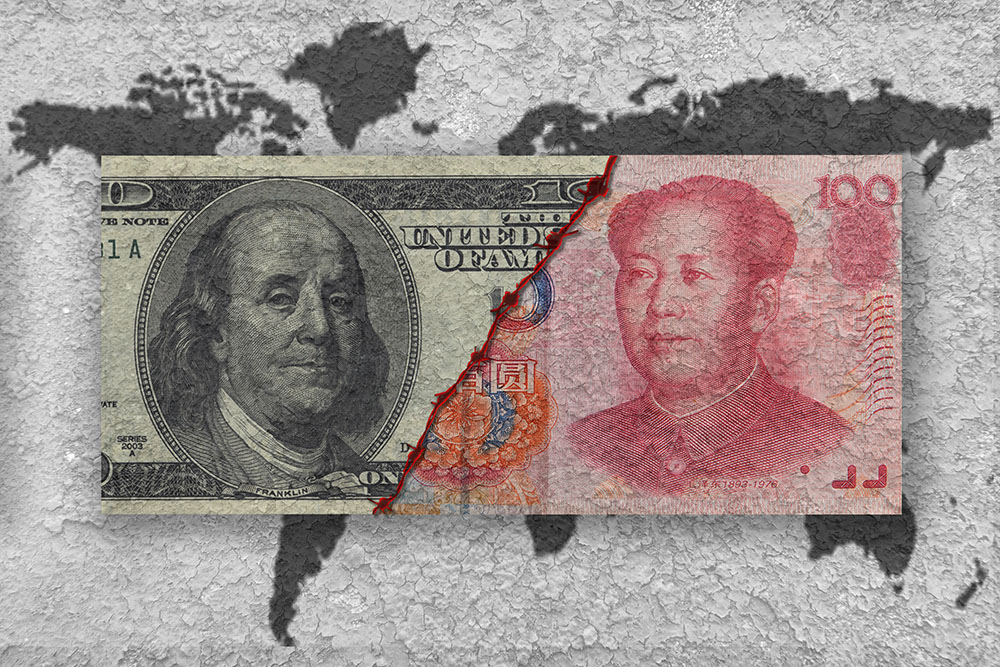
Once you’ve decided to counter China’s economic distortions and rebuild economic resilience, the question is not whether you’ve abandoned your principles – you have – but rather how to do so most effectively. For the US, the question is even more pressing because it is reacting so late, having already allowed China to gain a dangerous advantage.

Choose your ground carefully

The first point is not to fight on your adversary’s home turf. A free, consumer-oriented society like America is never going to be able to compete on subsidies with an authoritarian, high-savings nation like China. This is especially true given that the US already has an unsustainable deficit and debt. Competing on subsidies is a war of attrition the US can’t win.

Prudence, cost efficiency and jiu-jitsu

Tariffs are an attractive strategic response to China’s subsidized overcapacity for three reasons. First, rather than drain the national treasury, tariffs generate revenue. Second, they are a more cost effective means of re-industrialization. The cost of a subsidy is born wholly by national taxpayers, but the increased supply it creates benefits the whole world. Conversely, tariffs’ costs are in part born by one’s adversary’s exporters, while their benefits accrue solely to domestic industry. Third, just as jiu-jitsu turns an opponent’s weight advantage against them, tariffs turn China’s subsidy advantage against it. Subsidizing overcapacity is costly: the fiscal cost of direct subsidies, the losses accrued by state-owned enterprises, and by banks and bad-asset managers when businesses fail. Closing America’s markets to Chinese products increases those losses, and losses are amplified further by the “tariff funnel” created as other markets restrict access to Chinese goods as a condition of trade deals with the US.

Efficacy over efficiency

Neoliberalism on both sides of the aisle dies hard, hence the bipartisan CHIPS and Science Act to subsidize semiconductor manufacturing in the US was tailored for economic efficiency over national security efficacy. The scope of the subsidy was broad – to allow markets to decide what type of chips (or their inputs) should be built in the US – and focused on creating production capacity. While US manufacturing requires all grades of chips, their criticalities differ. But broad subsidies encouraged markets to allocate capital to the highest profit opportunities, not the most critical to US national security. Further, the Act’s focus on capacity rather than minimum production does nothing to ensure sustained US supply if prices fall below marginal cost. Both characteristics make the CHIPS Act’s subsidies vulnerable to natural market fluctuations and Chinese industrial policies.

Targeted selection

In contrast, the MP investment and price support deal is structured to be effective at the cost of efficiency. The US Defense Department picked the winner, potentially reducing competition and efficiency, although in this case somewhat mitigated by the narrow field of rare earths refiners still operating in the US. In return, the US gains greater surety of a larger and sustained supply of critical minerals. By taking a stake in the MP’s preferred shares, the government provided critical capital for expansion that MP was able to leverage with private-sector loans. The Defense Department also guaranteed a price floor and committed to buy all of MP’s expanded capacity. The price floor and orders ensures that MP can sustain a profit and remain in business. But in combination with tariff protections, the Defense Department’s monopolization of MP’s supply ensures that private US demand – e.g. for autos – extends the price floor across other US rare earths refiners.

Pragmatism over principle

Contrary to opponents’ characterization of it, the revenue-sharing agreements with NVIDIA and AMD represent a triumph of pragmatism that benefits US national security, the US Treasury and both companies. The alternative advocated by some was to place controls on the chips the deal applies to. Such controls have proven ineffective – DeepSeek used controlled NVIDIA chips99 – as Chinese companies just purchased them at a premium through middlemen. Under the new deal, China will now be able to legally purchase NVIDIA and AMD chips – helping to diffuse tensions with China – but the US Treasury captures the middlemen’s spread. At the margin, NVIDIA may also be correct that using their chips slows development of Huawei’s.

Homework: optimizing second best?

This is not to say that I am comfortable with governments picking winners or that the Trump Administration’s economic statecraft has been flawlessly designed. State interventions in markets amplify opportunities for corruption and may restrain innovation and productivity. But as I have shown, the world economy already is deeply distorted and has lower welfare due to China’s economic statecraft. The challenge is to design geoeconomic responses that maximize the second-best outcome (and hopefully improve global security in the process). Despite its newfound faddishness, economic statecraft remains woefully understudied in the West. Rather than build yet another n+1 iteration of the Neo-Keynesian model, perhaps more academic economists could research optimal second-best optimizations to counter harmful economic statecraft.
1

Nvidia and AMD to pay 15% of China chip sale revenues to US government,” Demetri Sevastopulo & Michael Acton, Financial Times, 10 August 2025; and “Nvidia, AMD to Give U.S. 15% Cut on AI Chip Sales to China,” Amrith Ramkumar & Robbie Whelan, The Wall Street Journal, 10 August 2025.

2

Investor’s grapple with Trump’s corporate America,” Katie Martin, Financial Times, 16 August 2025; “Why government should not intervene in business,” Op-ed, Washington Post, 11 August 2025; and “The U.S. Marches Toward State Capitalism With American Characteristics,” Greg Ip, The Wall Street Journal, 10 August 2025.

3

American National Security Principles Are Negotiable for the Right Fee,” Cale Hunt, Windows Central, 11 August 2024.

4

„Der Krieg ist eine bloße Fortsetzung der Politik mit anderen Mitteln,“ or in English, “War is merely the continuation of policy by other means.” On War, Carl von Clausowitz, edited and translated, Michael Howard & Peter Paret, Princeton University Press, 1 June 1989.

5

Global Chinese Development Financial Dataset (Version 2.0), AidData, William & Mary University, as of 18 August 2025.

6

China Hits Back at US Tariffs With Export Controls on Key Rare Earths,” Reuters/US News & World Report, 4 April 2025; and “Rare Earths and the East China Sea: Why hasn’t China embargoed shipments to Japan,” John Seaman, institut français des relations internationals, 5 October 2012.

7

Précis: Unrestricted Warfare,” Military Review, Army University Press, September-October 2019.

8

MP Materials Deal Marks a Significant Shift in US Rare Earths Policy,” Tom Moerenhout, Energy Explained, Center on Global Energy Policy, 11 July 2025.

9

Senators ask US to probe data security issues with DeepSeek,” David Shepardson, Reuters, 5 August 2025; “US House panel probes whether DeepSeek used restricted Nvidia chips,” Demetri Sevastopulo & Michael Acton, Financial Times, 16 April 2025; “Is China’s DeepSeek Using Smuggled AI Chips From Singapore?” Sebastian Strangio, The Diplomat, 3 February 2024; and “U.S. Probing Alleged DeepSeek Chip Deal in Singapore, Bloomberg Says,” Dow Jones/Morningstar, 31 January 2025.

Financial Disclosure and Disclaimer

The research, reports, and insights provided by Thematic Markets, Ltd are for informational purposes only and are not intended to constitute financial, investment, legal, tax, or other professional advice. The content is prepared without consideration of individual circumstances, financial objectives, or risk tolerances, and readers should not regard the information as a recommendation to buy, sell, or hold any specific securities, investments, or financial products.

Users of Thematic Markets, Ltd research are solely responsible for their own independent analysis, due diligence, and investment decisions. We strongly advise consulting qualified financial professionals or other advisors before making investment decisions or acting on any information provided in our materials.

The information and opinions provided are based on sources believed to be reliable and accurate at the time of publication. However, Thematic Markets, Ltd makes no representation or warranty, express or implied, as to the accuracy, completeness, or timeliness of the information. Markets, financial instruments, and macroeconomic conditions are inherently unpredictable, and past performance is not indicative of future results.

Thematic Markets, Ltd accepts no liability for any losses, damages, or consequences arising from the use of its research or reliance on the information contained therein. Readers acknowledge that investment decisions carry inherent risks, including the risk of capital loss.

This disclaimer applies globally and shall be enforceable in jurisdictions where Thematic Markets, Ltd, a company incorporated and based in England and Wales, operates. Readers in all jurisdictions, including but not limited to the United Kingdom, United States, Canada, European Union, Australia, Singapore, Japan, South Korea, and Taiwan, are responsible for ensuring compliance with local laws, rules, and regulations.

By accessing or using the research provided by Thematic Markets, Ltd, users agree to the terms of this disclaimer.

Comments are available to paid subscribers only.

Economic and market forecasts:

Economic & market forecasts
  • Sustained higher US rates, vulnerability of backend rates and term premia to steepening in H2 2023: Are we there yet? 

  • No recession, continued strength of US economy throughout 2023: Solved: Drivers of the dollar cycle; Clash of the Themes; Are we there yet?; Opportunity knocks: Are you listening?; Götterdämmerung.

  • No backtracking or “pivot” by the Fed in 2023: Solved: Drivers of the dollar cycle; Clash of the Themes; Are we there yet?; Opportunity knocks: Are you listening?; Götterdämmerung.

  • No banking crisis or reversal by the Fed following the failures of Silicon Valley Bank: Did QE cause bank failures? Opportunity knocks: Are you listening? 

  • No new “Plaza Accord” resulting from US dollar strength and Fed rate hikes in 2022: Plaza 2.0 bid, not offered

  • No default by Nigeria before or in the aftermath of the 2023 national elections: Debt reality versus perceptions

  • The continued fall in US real rates through the 2000s and early 2010s. Themes & framework: Mercantilism (with Chinese characteristics) and the associated $Bloc/Chinese co-prosperity sphere undermined the marginal product of capital in the US while simultaneously increasing non-US demand for US Treasuries.

  • Emerging market outperformance in the 2000s. Themes & framework: Mercantilism (with Chinese characteristics) drove both the development of the $Bloc/Chinese co-prosperity sphere and the commodity supercycle, while Apex neoliberalism supported institutional reforms that lowered EM risk premia, all of which encouraged foreign direct investment that raised productivity and led to rapid economic growth.

  • The end of emerging markets’ “original sin” and growth of EM local bond markets, a development supported by a G7 initiative that I led at the US Treasury. Themes & framework: The $Bloc/Chinese co-prosperity sphere provided a new stability in many EM exchange rates while institutional reforms undertaken by many as part of Apex neoliberalism lowered EM risk premia. 

  • The Global Financial Crisis (albeit see admission of errors below). Themes & framework: Mercantilism (with Chinese characteristics) and $Bloc/Chinese co-prosperity sphere simultaneously increased incentives for debt finance in the US (as demand for “safe” USD bonds rose globally) while undermining US means of repayment as the US marginal product of capital in traded goods fell.  Combined with poorly designed bank regulation that allowed banks to leverage themselves well beyond regulators’ intent (Apex neoliberalism), “complexity cascaded”.

  • The failure of QE to generate post-GFC inflation. Themes & framework: Believing is being: inflation expectations were stable to falling amid deleveraging and associated lethargic income growth, lowering real interest rates as nominal rates were pinned at the zero lower bound, and implying sustained weak money demand.  Stuffing banks with more reserves changed none of those variables.  As Keynes described seven decades earlier – in the absence of negative nominal rates – monetary policy at the zero lower bound is equivalent to “pushing on a string”.

  • The lack of effect of balance sheet runoff on interest rates. Themes & framework: Believing is being and portfolio theory rejected the then dominant “portfolio balance” theory of QE.  QE was a credible commitment by central banks to keep rates on hold, suppressing expectations for future rates and thus the yield curve.  This is why the “Taper Tantrum” had its largest effects on 3-5 year forward rates as expectations for rates hiked rose, while long-dated forward rates fell.  Measures of long-dated term premia continued to fall as the Fed reduced its balance sheet.

  • Peak Chinese growth in 2011. Themes & framework: Mercantilism (with Chinese characteristics) led to unsustainable contributions of investment to GDP and a collapse in China’s marginal product of capital amid historically large debt to GDP, a phenomenon that peaked with China’s 50% surge in domestic credit in response to the GFC.  Domestic funding of its debt trapped China within its own financial repression scheme, frustrating its efforts to unwind its $Bloc/Chinese co-prosperity sphere and internationalization the renminbi as a closed capital account is required to avoid savings flight and a collapse of the debt bubble. This self-funded debt bubble implies that losses from consequent overinvestment are “amortized” in the form of slower growth.

  • Emerging Market underperformance of the last decade (and likely future decade). Themes & framework: Institutional reform in EM peaked with US policy credibility before the GFC under Apex neoliberalism; China’s peak within Mercantilism (with Chinese characteristics) in 2011 and the associated end of the commodity supercycle ended the “pack” economic benefits of the $Bloc/Chinese co-prosperity sphere, while simultaneously the advent of Localization began to shift production back to advanced economies.  Amid stagnating growth and backsliding reforms, EM FX and asset prices looked (and continue to look) overvalued and risk spreads remain too thin.

  • Falling USD reserve share in the 2000s and a rising share since peak China. Themes & framework: The massive reserve accumulation required to sustain undervalution of the $Bloc/Chinese co-prosperity sphere came to be seen as “sovereign wealth” that required diversification, rather than a liquidity store for crises, and led to a consequent fall in the USD share of reserves.  Yet the greater financial openness and cross-border claims that accompanied the Apex neoliberalism necessarily implied a proportional increase in capital outflows in periods of risk aversion; i.e. historically large reserves were not as large as perceived in reality.  As China and the $Bloc/Chinese co-prosperity sphere slowed after 2011, and Global entropy increased Uncertainty with attendant effects on risk aversion, emerging markets learned painfully in 2014 that reserves were neither excess nor sovereign wealth, but instead necessary liquidity, and that the USD’s safe haven properties were unparalleled.

  • Low and falling inflation throughout the 2010s. Themes & framework: Missingflation, the unexplained trend component of global inflation that had led to two decades of inflation overforecasting by economists, showed no signs of abating and seemed to be caused by a continued slide in inflation expectations (Believing is being) as central banks struggled with the zero lower bound.  The end of the trend would require both for central banks to make more credible commitment to raise inflation in conjunction with a sustained positive inflation shock.

  • The (trend) bottoming of long-term US real rates, higher-than-expected peak in Fed funds rates and US equity outperformance in the last decade. Themes & framework:  China’s peak in 2011 under Mercantilism (with Chinese characteristics) and the dissolution of the $Bloc/Chinese co-prosperity sphere ended the trend of falling US real rates they had created.  But it wasn’t until Localization gathered sufficient steam – and the US private sector had deleveraged – that US openness and technological leadership sufficiently raised US returns to capital to support a rise in US real rates.  The Trump administration’s political support (Politics of Rage) for Localization gave another nudge to US relative returns to capital, and Covid again accelerated these phenomena further (and likely more sustainably).

  • The capitulation of Saudi Arabia’s price leadership/management in 2014 in the face of surging US tight oil production leading to lower and more volatile crude oil prices. Themes & framework: The end of the commodity supercycle brought about by peak China under Mercantilism (with Chinese characteristics) paused relentless crude oil demand growth, allowing innovation and a business-friendly US regime to undermined Saudi Arabia’s price leadership with tight oil production.  Cartel dynamics combined with Saudi Arabia’s long-run price maximization led to a collapse in Saudi-enforced OPEC discipline, and lower, more volatile crude oil prices.

  • Financial volatility’s shift to a lower median level with more frequent, shorter explosions during the last decade. Themes & framework: Rising Uncertainty in politics (Politics of Rage), geopolitics (Global entropy), technology (Localization), and policy (Missingflation) amid Complexity cascades shifted the relative shares of total risk away from quantifiable sources towards unquantifiable sources; the counter-intuitive implication of rising uncertainty is lower median volatility as active risk taking retreats in information lulls, with violent explosions of price activity when new information is revealed.

  • Persistence of post-Covid supply constraints and sustainable inflation supported by rearview-mirror central bank policies leading to a flip in the direction of Missingflation. Themes & framework: Covid simultaneously accelerated both the economic and political motivations for Localization, caused a permanent shift in the structure of global demand, and disrupted existing global supply chains. Short-run aggregate supply could not adjust to the jump in investment and shift in demand quickly enough, creating prolonged shortages and the need for prices to curtail demand. The associated cost-push inflation was all the spark needed to ignite Believing is being changes in inflation expectation driven by central banks’ backward-looking policies based on a lack of understanding of Missingflation.

  • The Fed’s post-Covid rate cycle would be more like 1994 than the post-2000 gradualist cycles (a call I made in early 2021). Themes & framework: The intent of the Fed’s FAIT policy always was to boost long-run inflation expectations by falling “behind the curve” on inflation.  Yet their lack of understanding of the causes of Missingflation and insufficient faith in their own ability to generate Believing is being kept them focused on “fighting the last war” too long, allowing inflation to run too hot, too quickly.  But contrary to market conventional wisdom, inflation is deeply politically unpopular in an aging society and no central banker wants to be remembered as failing to control inflation.  Accordingly, the Fed (eventually) will react forcefully to contain the Believing is being genie they underestimated.

  • Consistent underperformance of European economy, assets and the euro since the Global Financial Crisis. Themes & framework: Relative to trend growth, Europe was more highly indebted than the US, yet European policymakers too long considered the GFC an “American problem”.  Combined with Europe’s greater institutional rigidities and a reluctance to write down bad assets, it would take proportionately longer to achieve necessary deleveraging.  China’s 2011 peak within Mercantilism (with Chinese characteristics) and the rise of Localization undermined all parts of Europe: the globalization-dependent South and China-dependent North, while inflexibility and low levels of technological innovation inhibit Europe’s ability to adjust to the new global economic order.

  • UK outperformance of consensus Brexit forecasts. Themes & framework: Consensus forecast for post-Brexit UK were based on three flawed assumptions (due to underappreciation of themes!). First, by ignoring emergent Localization, growth forecasts grounded in Apex neoliberalism wrongly assumed globalization would continue to be a major driver of economic growth.  Second, the consensus failed to acknowledge the UK’s long-run structural competitiveness: world-leading universities providing a technological edge in Localization; and strong, enduring institutions offering safety and stability amid Global entropy and rising Uncertainty.  Third, the consensus, ironically, ignored the largest driver of trade (by a wide margin) in their own models: “gravity”, or proximity to trading partners.  Network effects are extraordinarily powerful in trade and difficult to overcome.

  • Importance and implications for markets of Scottish independence referendum in 2014. Themes & framework: As one of the earliest manifestations of the Politics of Rage and its demands for greater political representation, the Scottish referendum was an unanticipated shock to markets and one of the first signs of Global entropy and the Uncertainty to come.

Global entropy

Manifest and growing disorder

By ignoring the endogeneity of complex systems and Rodrick’s globalization trilemma – that democracy, national self-determination, and economic globalization cannot enduringly coexist – Apex neoliberalism sowed the seeds of its own demise, leading to today’s manifest and growing global disorder: the end of Post-World War II international rules, rising ethnonationalism, multipolarity, the Politics of Rage, and the unwinding of globalized supply chains.  In short, Huntington’s Clash of Civilizations trumped Fukuyama’s End of History.  Apex neoliberalism facilitated rising trade-to-income ratios, cross-border capital flows, intergovernmental cooperation, and intra-economy income inequality; while simultaneously lowering financial spreads, inter-economy income inequality, and inter-state warfare.  Global entropy likely will reverse many of these effects.

Missingflation

Economists don’t understand inflation

What are economists missing about inflation?  In the two decades before Covid, market analysts, academic economists and central banks consistently overforecast inflation; in the last two years they have persistently underforecast it.  Enduring one-way errors are not “white noise”; they demonstrate bias and strongly suggest that economists’ current understanding of inflation is flawed.  Demographics, globalization and technology help to explain some of the forecast miss, but significant omitted variable bias remains, most likely due to failure to explicitly incorporate Believing is being.

Believing is being

Self-fulfilling beliefs are real

Beliefs drive everything from asset bubbles, to debt dynamics, to crypto currencies’ values, to inflation and hyperinflations (probably Missingflation, too).  Good economists understand this but often omit beliefs from models to simplify because of the difficulty in measuring beliefs.  Unfortunately, too many bad economists copy those models without understanding the potential for omitted variable bias.  The rapid social, technological, political, and geopolitical changes behind Global entropy and Uncertainty are swiftly shifting beliefs, driving a feedback loop of economic and political outcomes.  Yet the infrequency of these deviations and difficulty in measuring them make statistical modeling nearly impossible.  Only through economic theory and full-spectrum information collection can we infer when and how beliefs are adjusting and their likely effects.

Complexity cascades

Complex systems fail unpredictably

Human societies, nation states and (especially) economies are examples of complex systems. Complex systems always operate in “broken” mode and ironically are more structurally stable when they have lots of small failures.  But when they are subjected to massive or cascading shocks, complex systems can fail unpredictably and totally.  Covid and manifest Global entropy represent self-reinforcing mammoth shockwaves that imply systemic collapses – in all spheres, socio-political, geopolitical, economic, and financial – are more likely than the consensus admits.

Uncertainty

Not all risks can be quantified

All risks are not the same.  Some are quantifiable, like the chance of being dealt an ace in a game of cards. Others are not but can be subjectively guessed, like the chance you leave a casino a winner. Then there is uncertainty, the most dangerous of all risks because it is by definition, non-quantifiable: what is the chance the casino gets hit by a meteor?  Apex neoliberalism created a façade of quantifiable risks; Global entropy and Complexity cascades are illustrating that the world is far more uncertain.  The quantitative models in finance, business, economics, and politics that gained dominance during Apex neoliberalism generally have performed poorly as Global entropy has become more pronounced, a trend that is likely to sustain as uncertainty rises further.  Scenario analysis and “satisficing” are the only proven frameworks for dealing with uncertainty.

Politics of Rage

The proletariat want their franchise back

Four decades ago, globalization and increasing economic returns to intellectual capital opened a fissure between elites and everyone else, especially in more developed economies.  The economic and political consequences of Apex neoliberalism widened this fissure into a chasm of mistrust that has resulted in the political turmoil that engulfed most advanced economies in the last decade.  Contrary to conventional wisdom, its causes derive more from perceived and actual political disenfranchisement than economic distress and inequality.  Trends in the former suggest the wave is not near cresting, implying sustained socio-political, geopolitical and economic disruptions.

$Bloc/Chinese co-prosperity sphere

FX herding cures “fear of floating”

The “co-prosperity sphere” of bloc managed exchange rates centered around Chinese trade and the US financial system, alternatively known as Bretton Woods II or Chimerica, dramatically reoriented global supply chains, supported emerging markets’ financial development and economic boom of the 2000s, drove much of the dollar’s 2002-’11 depreciation, and ultimately likely caused the Global Financial Crisis.  Emerging market crises of the late 1990s marked the final chapter in the Bretton Woods exchange rate system.  Yet “Fear of floating” persisted until China’s Mercantilism and contemporaneous accession to WTO provided an alternative: exchange rates managed by “herd” or by “pack”.  Hiding within the herd provided financial stability for China’s EM trading partners, while simultaneously allowing them hunt as a pack for foreign direct investment and supply-chain dominance.  The size and rapid growth of the co-prosperity sphere distorted the global economy like a massive stellar object warps space-time.  Collective suppression of exchange rates and domestic cost of capital diverted supply chain growth into the bloc, while attendant reserve accumulation led to a surge in demand for “safe” core economy bonds.  The former undermined returns to capital in traded goods production outside the bloc and the latter depressed interest rates on “safe” US debt, encouraging overinvestment in non-traded goods like housing.  (Note: I labeled this phenomenon “the dollar bloc” when I first wrote about it in 2003-04, but later referred to it as “the co-prosperity sphere”.)

Mercantilism (with Chinese Characteristics)

State capitalism’s unintended costs

China’s 1994-2012 “miracle” that lifted nearly a billion people out of poverty and its current growth problems both originate in its extreme application of the mercantilist “Asian growth model” originated by Japan and later copied by Asia’s “Tigers”.  A combination of capital controls, protectionism, domestic financial repression, and industrial policy direct underpriced capital to favored industries that promote rapid capital accumulation and development by leveraging external demand (and technology) from advanced economies. Rapid development and convergence comes at cost, however.  Underpriced capital and exchange rates lead to distortive overinvestment.  Those losses are realized either abruptly and painfully through write downs – like those enforced on late-‘90s Asian Crisis economies by the IMF – or, if the economy can self fund, are “amortized” as lost future growth.  Japan’s lost decade and China’s current funk are examples of the amortization path of economic loss.

Apex neoliberalism

Liberal capital democracy’s pyrrhic victory

Rapid global growth, particularly in the less developed world, “hyperglobalized” production and the growth of inter-governmental coordination derive substantively from the triumph of neoliberalism that followed the collapse of its ideological competitors with the Soviet Union’s fall and emerging market crises of the 1990s. But so too did the seeds of its undoing: The Politics of Rage, Mercantilism (with Chinese characteristics), Missingflation, and ultimately Global entropy.  Rapid adoption of Western economic institutions and trade mechanisms followed from neoliberalism’s victory, promoting a world of hyperglobalization: ever-more dispersed but integrated global supply chains, just-in-time industrial processes with reduced redundancy, unfettered cross-border capital flows, and uniform rules that increased the influence of international institutions, non-governmental organizations and multinationals at the expense of local political control and less-skilled citizenry.  Resultant uniformity and coincident digitization created a façade of certainty and quantification, promoting an overreliance on quantitative methods in decision processes, risk control and forecasting.

Economic and market phenomena:

Economic & market forecasts
  • The continued fall in US real rates through the 2000s and early 2010s.  Themes & framework: Mercantilism (with Chinese characteristics) and the associated $Bloc/Chinese co-prosperity sphere undermined the marginal product of capital in the US while simultaneously increasing non-US demand for US Treasuries.
     
  • Emerging market outperformance in the 2000s.  Themes & framework: Mercantilism (with Chinese characteristics) drove both the development of the $Bloc/Chinese co-prosperity sphere and the commodity supercycle, while Apex neoliberalism supported institutional reforms that lowered EM risk premia, all of which encouraged foreign direct investment that raised productivity and led to rapid economic growth.
     
  • The end of emerging markets’ “original sin” and growth of EM local bond markets, a development supported by a G7 initiative that I led at the US Treasury.  Themes & framework: The $Bloc/Chinese co-prosperity sphere provided a new stability in many EM exchange rates while institutional reforms undertaken by many as part of Apex neoliberalism lowered EM risk premia.
     
  • The Global Financial Crisis (albeit see admission of errors below).  Themes & framework: Mercantilism (with Chinese characteristics) and $Bloc/Chinese co-prosperity sphere simultaneously increased incentives for debt finance in the US (as demand for “safe” USD bonds rose globally) while undermining US means of repayment as the US marginal product of capital in traded goods fell.  Combined with poorly designed bank regulation that allowed banks to leverage themselves well beyond regulators’ intent (Apex neoliberalism), “complexity cascaded”.
     
  • The failure of QE to generate post-GFC inflation.  Themes & framework: Believing is being: inflation expectations were stable to falling amid deleveraging and associated lethargic income growth, lowering real interest rates as nominal rates were pinned at the zero lower bound, and implying sustained weak money demand.  Stuffing banks with more reserves changed none of those variables.  As Keynes described seven decades earlier – in the absence of negative nominal rates – monetary policy at the zero lower bound is equivalent to “pushing on a string”.
     
  • The lack of effect of balance sheet runoff on interest rates.  Themes & framework: Believing is being and portfolio theory rejected the then dominant “portfolio balance” theory of QE.  QE was a credible commitment by central banks to keep rates on hold, suppressing expectations for future rates and thus the yield curve.  This is why the “Taper Tantrum” had its largest effects on 3-5 year forward rates as expectations for rates hiked rose, while long-dated forward rates fell.  Measures of long-dated term premia continued to fall as the Fed reduced its balance sheet.
     
  • Peak Chinese growth in 2011.  Themes & framework: Mercantilism (with Chinese characteristics) led to unsustainable contributions of investment to GDP and a collapse in China’s marginal product of capital amid historically large debt to GDP, a phenomenon that peaked with China’s 50% surge in domestic credit in response to the GFC.  Domestic funding of its debt trapped China within its own financial repression scheme, frustrating its efforts to unwind its $Bloc/Chinese co-prosperity sphere and internationalization the renminbi as a closed capital account is required to avoid savings flight and a collapse of the debt bubble. This self-funded debt bubble implies that losses from consequent overinvestment are “amortized” in the form of slower growth.
     
  • Emerging Market underperformance of the last decade (and likely future decade).  Themes & framework: Institutional reform in EM peaked with US policy credibility before the GFC under Apex neoliberalism; China’s peak within Mercantilism (with Chinese characteristics) in 2011 and the associated end of the commodity supercycle ended the “pack” economic benefits of the $Bloc/Chinese co-prosperity sphere, while simultaneously the advent of Localization began to shift production back to advanced economies.  Amid stagnating growth and backsliding reforms, EM FX and asset prices looked (and continue to look) overvalued and risk spreads remain too thin.
     
  • Falling USD reserve share in the 2000s and a rising share since peak China.  Themes & framework: The massive reserve accumulation required to sustain undervalution of the $Bloc/Chinese co-prosperity sphere came to be seen as “sovereign wealth” that required diversification, rather than a liquidity store for crises, and led to a consequent fall in the USD share of reserves.  Yet the greater financial openness and cross-border claims that accompanied the Apex neoliberalism necessarily implied a proportional increase in capital outflows in periods of risk aversion; i.e. historically large reserves were not as large as perceived in reality.  As China and the $Bloc/Chinese co-prosperity sphere slowed after 2011, and Global entropy increased Uncertainty with attendant effects on risk aversion, emerging markets learned painfully in 2014 that reserves were neither excess nor sovereign wealth, but instead necessary liquidity, and that the USD’s safe haven properties were unparalleled.
     
  • Low and falling inflation throughout the 2010s.  Themes & framework: Missingflation, the unexplained trend component of global inflation that had led to two decades of inflation overforecasting by economists, showed no signs of abating and seemed to be caused by a continued slide in inflation expectations (Believing is being) as central banks struggled with the zero lower bound.  The end of the trend would require both for central banks to make more credible commitment to raise inflation in conjunction with a sustained positive inflation shock.
     
  • The (trend) bottoming of long-term US real rates, higher-than-expected peak in Fed funds rates and US equity outperformance in the last decade.  Themes & framework:  China’s peak in 2011 under Mercantilism (with Chinese characteristics) and the dissolution of the $Bloc/Chinese co-prosperity sphere ended the trend of falling US real rates they had created.  But it wasn’t until Localization gathered sufficient steam – and the US private sector had deleveraged – that US openness and technological leadership sufficiently raised US returns to capital to support a rise in US real rates.  The Trump administration’s political support (Politics of Rage) for Localization gave another nudge to US relative returns to capital, and Covid again accelerated these phenomena further (and likely more sustainably).
     
  • The capitulation of Saudi Arabia’s price leadership/management in 2014 in the face of surging US tight oil production leading to lower and more volatile crude oil prices.  Themes & framework: The end of the commodity supercycle brought about by peak China under Mercantilism (with Chinese characteristics) paused relentless crude oil demand growth, allowing innovation and a business-friendly US regime to undermined Saudi Arabia’s price leadership with tight oil production.  Cartel dynamics combined with Saudi Arabia’s long-run price maximization led to a collapse in Saudi-enforced OPEC discipline, and lower, more volatile crude oil prices.
     
  • Financial volatility’s shift to a lower median level with more frequent, shorter explosions during the last decade.  Themes & framework: Rising Uncertainty in politics (Politics of Rage), geopolitics (Global entropy), technology (Localization), and policy (Missingflation) amid Complexity cascades shifted the relative shares of total risk away from quantifiable sources towards unquantifiable sources; the counter-intuitive implication of rising uncertainty is lower median volatility as active risk taking retreats in information lulls, with violent explosions of price activity when new information is revealed.
     
  • Persistence of post-Covid supply constraints and sustainable inflation supported by rearview-mirror central bank policies leading to a flip in the direction of Missingflation.  Themes & framework: Covid simultaneously accelerated both the economic and political motivations for Localization, caused a permanent shift in the structure of global demand, and disrupted existing global supply chains. Short-run aggregate supply could not adjust to the jump in investment and shift in demand quickly enough, creating prolonged shortages and the need for prices to curtail demand. The associated cost-push inflation was all the spark needed to ignite Believing is being changes in inflation expectation driven by central banks’ backward-looking policies based on a lack of understanding of Missingflation.
     
  • The Fed’s post-Covid rate cycle would be more like 1994 than the post-2000 gradualist cycles (a call I made in early 2021).  Themes & framework: The intent of the Fed’s FAIT policy always was to boost long-run inflation expectations by falling “behind the curve” on inflation.  Yet their lack of understanding of the causes of Missingflation and insufficient faith in their own ability to generate Believing is being kept them focused on “fighting the last war” too long, allowing inflation to run too hot, too quickly.  But contrary to market conventional wisdom, inflation is deeply politically unpopular in an aging society and no central banker wants to be remembered as failing to control inflation.  Accordingly, the Fed (eventually) will react forcefully to contain the Believing is being genie they underestimated.
     
  • Consistent underperformance of European economy, assets and the euro since the Global Financial Crisis.  Themes & framework: Relative to trend growth, Europe was more highly indebted than the US, yet European policymakers too long considered the GFC an “American problem”.  Combined with Europe’s greater institutional rigidities and a reluctance to write down bad assets, it would take proportionately longer to achieve necessary deleveraging.  China’s 2011 peak within Mercantilism (with Chinese characteristics) and the rise of Localization undermined all parts of Europe: the globalization-dependent South and China-dependent North, while inflexibility and low levels of technological innovation inhibit Europe’s ability to adjust to the new global economic order.
     
  • UK outperformance of consensus Brexit forecasts.  Themes & framework: Consensus forecast for post-Brexit UK were based on three flawed assumptions (due to underappreciation of themes!). First, by ignoring emergent Localization, growth forecasts grounded in Apex neoliberalism wrongly assumed globalization would continue to be a major driver of economic growth.  Second, the consensus failed to acknowledge the UK’s long-run structural competitiveness: world-leading universities providing a technological edge in Localization; and strong, enduring institutions offering safety and stability amid Global entropy and rising Uncertainty.  Third, the consensus, ironically, ignored the largest driver of trade (by a wide margin) in their own models: “gravity”, or proximity to trading partners.  Network effects are extraordinarily powerful in trade and difficult to overcome.
     
  • Importance and implications for markets of Scottish independence referendum in 2014.  Themes & framework: As one of the earliest manifestations of the Politics of Rage and its demands for greater political representation, the Scottish referendum was an unanticipated shock to markets and one of the first signs of Global entropy and the Uncertainty to come.

Foreign exchange forecasts:

Foreign exchange forecasts
  • The dollar’s trend fall 2002-’11. Themes & framework: The effects of the $Bloc/Chinese co-prosperity sphere on relative returns to capital, balance of payments and the effects of “diversification” as sovereign reserves evolved into sovereign wealth.

  • The dollar’s trend turn in 2011, surge 2014-2016, and counter-consensus strength in 2018 and 2021 (I was the only sell-side analyst to forecast USD strength in 2021). Themes & framework: The same forces driving the US real rates higher in the last several years – the end of Mercantilism (with Chinese characteristics) and its associated $Bloc/Chinese co-prosperity sphere, disproportionate benefit to the US from accelerating Localization, Global entropy and Complexity cascades, all played out in the USD, too, with added support from increased safe haven demand for the greenback due to rising Uncertainty brought about by Global entropy and Complexity cascades.

  • The euro’s plunge from $1.36 in mid 2014 to $1.05 in early 2015. Themes & framework: Reluctant deleveraging from the Global Financial Crisis combined with the sharp deterioration in European returns to capital following China’s peak within Mercantilism (with Chinese characteristics) and the shift to Localization from globalization implied a sharply lower real value of the euro. When ECB President Draghi ruled out the deflationary (1990s Japan) path to devaluation with his commitment to “whatever it takes”, Believing is being implied an immediate and massive change in the nominal value of the euro was required as the expected path for domestic prices flipped.

  • The yen’s surge from above 120 per dollar to below 105 in H1 2016. Themes & framework: Abenomics’ biggest success was its Believing is being commitment to reflate Japan’s economy, leading to a sharp depreciation of the nominal yen as expected future deflation was unwound. But yen depreciation included an “overshoot” to compensate for the risks that inflation might overshoot. The Bank of Japan’s tacit admission that “Quantitative & Qualitative Easing” could not create sufficient inflation with its December 2015 adoption of negative interest rates implied a rapid unwind of the overshoot given the yen’s deep undervaluation as beliefs shifted again.

  • The pound sterling’s pre-EU referendum fall to $1.40, post-referendum floor near $1.20, and its post-Brexit rebound above $1.30. Themes & framework: A steep risk premium in sterling was required to compensate for the Uncertainty induced by the Politics of Rage driven jolt.  Yet, 1.20 represented a 60+ year low in purchasing power parity and seemed to undervalue the UK’s long-run structural assets – strong institutions, top global universities, leading tech industry – all of which were appreciating in value in a world of Localization, Global entropy, broader Uncertainty, and rising potential for Complexity cascades.

Political forecasts:

  • Political instability in Russia and China in 2023: Clash of the Themes.

  • Brexit 2016. Themes & framework: The chasm between elites (including those in markets) and ordinary citizens over the latter’s sense of disenfranchisement, the fundamental cause of the Politics of Rage, was clear well before the referendum and strongly suggested that bias in polling turnout models could fully account for the polls’ projected margin of defeat.

  • Trump 2016. Themes & framework: Record pre-election postal votes from registered independents (for whom no party seeks to “get out the vote”) suggested that, as with Brexit, the Politics of Rage’s disenfranchised and unaccounted for voters would be sufficient to overcome the (narrow) projected margin of loss.

  • Marine Le Pen’s 2017 success in reaching the run-off but ultimate failure to win French presidency. Themes & framework: The Politics of Rage framework suggested an undercounting of both Le Pen and left-wing populists’ support, giving her a clear path to the second round. But her projected margin of loss in the general election was far too large to be due solely to turnout bias, implying no chance of second-round success, particularly with left-wing populist voters dropping out or shifting support to Macron.

  • Trump narrow loss, post-election conflict 2020. Themes & framework: Pollsters’ mistaken focus on education levels as the source of their 2016 turnout errors rather than on (mis)trust driven by the Politics of Rage implied polls still were biased. Large shifts in minority voters towards Trump and unusually high “undecided” voters late in a highly polarized election also suggested the magnitude of Trump’s outperformance would be large (indeed, it was larger than 2016).  But the margin to overcome also was much wider in 2020, suggesting a close loss by Trump. Increasing polarization and mistrust on both sides implied a violent reaction by a minority, whichever side lost.

Admission of errors:

I get things wrong, too, but hopefully am the wiser for it.  This list is far from complete, but represents some of the ones that both stung and taught me the most.

  • Failing to specify financial institutions as at risk from credit trauma in 2023. While I did highlight that the most predictable source of for 2023 would be credit events following the massive rise in interest rates in 2022 (Debt reality versus perceptions), I didn’t specifically identify banks and other financial institutions as especially vulnerable, which proved to be the case with the failure of a few regional US banks in March 2023. Lessons learnt: Sometimes one’s focus on the underlying causes blinds to the obvious consequences, and levered entities with broad exposure will always be at risk from any traumas within an economy, even if sector or region specific.

  • Not seeing the Global Financial Crisis sooner. I saw the GFC earlier than many, but the extent of the financial system’s capital shortfall eluded me far longer than it should have.  At the US Treasury from 2006 through early 2008 I was responsible for assessing foreign financial risks (sadly, institutional territorialism prevented an integrated approach with my domestic-side colleagues that may have focused more attention on off-balance-sheet financing of US housing).  I chaired meeting after meeting in 2006-‘07 with market professionals, academics, regulators, and other policymakers where a noisy minority of participants argued that historic levels of debt to GDP implied an impending crisis.  Yet when I challenged them to explain a channel of transmission, what would be the tipping point, why it had not occurred already, or to present evidence that bank capital was insufficient to absorb even an historic drop in US housing prices, none – including some who have become very famous for “calling” the GFC – could do so.  Ultimately, it was the behavior of banks in funding markets in mid-to-late 2007 that clued me in that banks’ capital bases might not be what they purported (or, equivalently, contingent liabilities off balance sheet were far larger than people understood).  What I had not done – nor, apparently had any of the “experts” I consulted in those years – was the detailed micro-level analysis that the protagonists of The Big Short had done (kudos to them).  Lessons learnt: 1. “Macro” analysis often requires “micro foundations”; 2. many people claim expertise, don’t rely on it without evidence; and 3. notwithstanding (2), even if they can’t explain it, pay attention when a gathering minority claim to smell smoke. (Implicit lesson 4: don’t assume that the left hand is talking to the right hand in any organization.)

  • Losing my nerve at the bottom of markets in 2009. My framework helped me to correctly call the bottom in credit markets in January 2009 and recommend to the distressed debt fund I then worked for that we aggressively buy leveraged loans.  But on market research mission in late February, I got spooked by US Treasury and Fed officials I met in New York and Washington.  Throwing my framework out the window, on 6 March 2009, the exact day the S&P 500 hit its 666 low, I wrote a memo urging the fund to sell SPX futures as a hedge on its market exposure.  Lessons learnt: 1. Never abandon your framework; and 2. don’t assume someone’s position or pedigree alone gives them an informational or analytical advantage: demand reasons and evidence.

  • Missing the euro’s partial rebound in 2017; indeed, I forecast it lower! I failed to acknowledge the extent of the uptick in economic activity, and importantly, the credit growth that the ECB’s “anything it takes” policy was generating.  This one stung as I was a strong believer in then-President Mario Draghi’s approach and had previously highlighted credit expansion as a key metric of success.  Lessons learnt: Keep your eyes on the ball and regularly check to see if any of the ex ante conditions established for changing your mind have been met.

  • Dollar weakness in summer 2020. Another one that really stings.  Having correctly forecast that Covid-induced Uncertainty would lead to a surge in the USD as everyone scrambled for high-quality assets and liquidity in March-April 2020, I then failed to incorporate the unwind of that flight to quality as risk tolerance returned once the panic subsided.  Lesson learnt: Sadly, the same as 2017 dollar lesson: Keep your eyes on the ball and mind your pre-established conditions for turning points.

  • I completely missed the Fed’s mini easing cycle in 2019. While we will never know and Covid eviscerated my chance at redemption, I still believe the Fed’s easing was not merited and likely would have necessitated more aggressive hiking later had the Covid crisis not intervened.  The US economy continued to grow strongly in 2019, investment held up, and while headline inflation moderated somewhat, bottlenecks were generating rapid acceleration in a number of CPI subcomponents.  But even if I was right on the economy, the FOMC sets policy and I failed to listen to them, particularly the increasing support for average inflation targeting.  Lessons learnt: Policymakers set policy, listen to them even if you think they’re wrong.

  • Underestimating Jeremy Corbyn in the 2017 UK general election. I expected a small Conservative victory based on then Prime Minister Theresa May’s outreach to the working class and the Labour Party’s anti-Brexit tone.  What I failed to notice was that Mr. Corbyn’s grass-roots campaign cleverly focused on local bread-and-butter issues and greater political devolution, directly addressing one of the primary drivers of the Politics of Rage: a widening sense of political disenfranchisement among the average citizenry.  Corbyn’s tangible policies and outreach – which he largely abandoned in his losing 2019 campaign – easily trumped Ms. May’s intangible rhetoric as “hidden” Brexit voters didn’t trust her.  Lessons learnt: Again, “macro” analysis needs “micro foundations”, particularly in politics; ignore at your own peril.

  • Texas Governor Rick Perry to win the 2012 Republican nomination and beat President Barack Obama in the general election. The foundations of the Politics of Rage were already well apparent by the 2012 election and Rick Perry’s campaign was well tuned to court the rising sense of disenfranchisement of working-class voters, particularly in Appalachia, and increasing distrust of institutional expertise across voters.  Many of those voters were Democrats who were disappointed with the lack of “Hope and Change” promised by President Obama, making him vulnerable to any Republican who could attract a significant number of Democratic voters.  Governor Perry’s bigger challenge appeared to be winning the Republican nomination, but his solid conservative credentials and popularity in the second-largest state suggested he would eek it out.  Who knew he would self-immolate in a nationally televised debate?  Lessons learnt: Themes are important – Trump proved the Politics of Rage four years later – but idiosyncratic risks always are present.