

Misconceptions about debt
Reading the news (or social media), you could be forgiven for thinking that bond markets and the Secretary of the Treasury are panicked over an impending US debt crisis, that the Federal Reserve has no choice but to lower interest rates, accelerating inflation, and that the dollar is running off a cliff like Wile E. Coyote. The reality is quite different. Bond yields reflect strong US growth and increasing global competition for savings from wars and the AI boom; the Secretary of the Treasury is spending less than 1% of the federal budget retiring older, deeply discounted US Treasuries, facilitating their liquidity and reducing nominal debt obligations; and the dollar remains around its average for the last decade, just off multi-decade highs. Is the US facing a debt crisis? Can it “inflate” its debt away? Is the dollar under threat? This week I’ll cut through the hyperbole to explain the US debt problems and what they imply.
Household budget analogies
It is usually a mistake to relate national finances to household budgeting, but it does help define terms and concepts. Understanding the difference between flows (the change in financial condition) and stocks (outstanding amounts) is a necessary starting point. If you spend more than you earn, the difference — how much you need to borrow each period — is a deficit. A deficit is a flow, like its positive counterpart, a surplus, when you earn more than you spend. When you run persistent deficits, you accumulate debt, a stock of liabilities owed to creditors. The opposite, when you run persistent surpluses, is to accumulate a stock of assets.
Debt capacity
My focus on stocks versus flows is deliberate because, while much of the hyperbole is (wrongly) focused on the level of US debt — and even more wrongly, on the nominal value outstanding — flows are far more important in evaluating repayment risk. When you apply for an auto loan — whether it is for a £25,000 Toyota Corolla or a £250,000 Bentley Continental GT — what is the first question that the bank asks? “What is your income?” That’s because repayment ability is more closely associated with the flow of your income, or your capacity to make regular payments, than the outstanding amount of the loan. That isn’t to say that the loan value isn’t important — the bigger the loan, the greater the risk for the bank if you lose your job — just that a buyer’s income matters far more.
Sovereign privileges
There are two big differences between households and nations. The first is that household debt is tied to an individual with a finite lifespan. Sovereigns, in contrast, have infinite lives (at least in theory). Thus, while a 60-year-old may find it difficult to refinance an outstanding loan, a 250-year-old nation like America can roll over its debts indefinitely so long as it appears able to repay them. This is critical to understanding how a country can simply “grow out” of its debt. No matter how large a country’s debt is, if its creditors are willing to refinance its debt and — this is the critical bit — the nation stops taking out new debt, its debt will shrink relative to income (GDP) as the country grows. Hence, a sovereign can solve a debt crisis by simply balancing its budget and convincing its creditors that it is doing so permanently.
It’s good to be the king
The second sovereign advantage is that it can coin its own money and — if it doesn’t abuse that privilege too often — can denominate debt in its own currency. That gives a nation a “free” source of revenue: seigniorage. Typically, money demand grows with an economy’s size since money is required to facilitate (growing) transactions. The sovereign thus “earns” seigniorage as its central bank prints new money to meet rising money demand. It’s important to note that this is true even without inflation: a nation growing with no inflation still collects seigniorage on the required growth in the money supply. But inflation can increase seigniorage — up to a point — since money demand grows with the nominal value of transactions, not their volume. So, higher inflation generates higher seigniorage. That’s a tempting tool to abuse subject to two constraints: citizens may rebel against higher inflation and creditors may stop lending in the sovereign’s currency. There are plenty of historical examples of both.
Final terms
There are a few other terms related to sovereign finance that I need to define. The first is revenue: state income from taxes, seigniorage, natural-resource royalties, tariffs, and the like. The second is expenditure, i.e. state spending on defense, infrastructure, social welfare, and interest. It is also helpful to define non-interest expenditures and fiscal balances (deficits or surpluses), since these are critical to fiscal sustainability, as we will see. That’s because all other expenditures — yes, even Social Security, America — can be changed on sovereign whim, but a sovereign that attempts to change the contractual terms of its debt quickly finds itself without willing creditors. Further, as I will show, the primary balance — the non-interest deficit or surplus — is arguably the most important variable on which to focus when assessing US debt sustainability. Importantly, all of these variables — without a change in fiscal policy — grow at roughly the rate of GDP.
Defining sustainability
Now that we have some necessary terms defined, let’s tackle what “debt sustainability” — a debt that can be refinanced indefinitely — actually means. Contrary to the claims of alarmists, this has very little to do with nominal interest expenses or “non-discretionary” entitlement spending. Indeed, a sovereign might not even have to balance its annual budget. As long as real (inflation-adjusted) interest rates are lower than real growth rates and the primary (non-interest) deficit is not too large, even a country with a large debt — e.g. 100% of GDP — can achieve sustainability. Note carefully that the variables that matter are real, not nominal. That’s because the inflationary component of both nominal GDP growth and nominal interest rates effectively cancel each other out.1[1]
Stabilising debt to income
In its simplest terms, sustainability is defined by sovereign debt that is either stable or falling relative to national income. Notice that says nothing about the absolute dollar value of the debt or what interest payments are. What is required is that debt grow no faster than national income (i.e. GDP). Stable debt/GDP implies that fiscal revenue — which grows roughly in line with GDP — is growing as fast as interest payments and new borrowing (or as augmented by fiscal surpluses). As with our Bentley example, this is not to say that the level of debt doesn’t matter: economic catastrophes happen, governments change and repudiate past debts, and occasionally, nations are wiped off the map. But in the absence of such (typically unpredictable) external shocks, creditors generally are happy to roll over outstanding debt when it is on a stable path relative to a country’s GDP.
An illustrative example
An example helps to illustrate the arithmetic.2[2] Let’s suppose that the Kingdom of Narnia has debt equal to 100% of GDP, a primary budget deficit of 1% of GDP, real growth of 2% per year, real interest rates of 1% per year, and inflation of 5% per year.
New debt/GDP = 100% old debt/old GDP x 6% nominal interest* + 1% primary deficit (non-interest deficit) = 107% new debt/old GDP*6% nominal interest = 1% real interest + 5% inflation; mathematically correct, this should be the gross interest rate, i.e. 106%.
But next year’s GDP will also be 7% larger:
New GDP= old GDP (100%) x 7% nominal growth* = 107% of old GDP*7% nominal growth = 2% real growth + 5% inflation; mathematically correct, this should be the gross nominal growth rate, i.e. 107%.
Voilà! Debt to GDP is stable at 100% (107/107). I’ll let you work out at home that we can just ignore inflation and get the same answer.
Debt outstanding is second order
Here’s something else to play with at home: the effects of changing each variable incrementally. With debt equal to income — a high debt level by definition — changes in the primary deficit are critical: every percentage point change in it changes the subsequent year’s debt to GDP by the same amount. The same holds for the difference between real growth and real interest rates: a one percentage point rise in real interest rates (or fall in GDP growth) adds one percentage point to debt to GDP each year. Now consider a one percentage point increase in debt outstanding: the above math barely changes. You would need to double debt-to-GDP to have the same effect as a one percentage point change in either the primary deficit or the growth/interest-rate differential. This is why I said above that the primary deficit is far more important to debt sustainability than the level of debt.
A real example: USA
Now let’s look at how these apply to the United States. Using 2025 numbers, the last full year available, US net government debt is 96.7% of GDP and the primary fiscal deficit is 3.17% of GDP.3[3] I’m using net debt to consolidate debt the government owes itself (e.g. Fed holdings of Treasuries whose interest is remitted back to the Treasury). For real growth I use my pre-Covid estimate of long-run (potential) US GDP growth of 2.25%, which is conservative given that the average of the most recent four years (excluding Covid volatility) is 2.84%. To incorporate market expectations for both future inflation and costs of rolling over existing debt, I use the current 5-year Treasury Inflation-Protected Securities (TIPS) yield that, coincidentally, also is 2.25%.4[4] Let’s plug these numbers into the above math (dropping the superfluous inflation terms):
New debt/GDP = 96.7% old debt/old GDP x 2.25% real interest
+ 3.17% primary deficit (non-interest deficit)
= 102.05% new debt/old GDP
But next year’s GDP will also be 2.25% larger:
New GDP= old GDP (100%) x 2.25% real growth
= 102.25% of old GDP
Thus, the new ratio of debt to GDP is 102.05/102.25, or 99.8% of GDP, meaning that the US debt-to-GDP ratio is growing at 3.1 percentage points per year (99.8% – 96.7%).5[5] Put another way, despite the recent rise in interest rates, it is the US primary deficit that is driving US debt unsustainability.
Stopping the train
That can’t continue forever, and as Herb Stein once quipped, “If something cannot go on forever, it will stop.” But it also doesn’t (yet) merit panic stations, which helps explain why bond markets aren’t sounding the alarm for imminent default (or monetization). This immutable debt math also explains Treasury Secretary Scott Bessent’s original “3-3-3” economic plan: 3% real growth, 3% budget deficit, and 3 million barrels per day of additional oil production. A 3% budget deficit (including interest) would equate to a primary surplus of about 1% of GDP, which would shrink US debt to GDP by about 1.7 percentage points per year with 3% growth. The Trump Administration has made little progress towards those goals — maybe that’s why Secretary Bessent has stopped mentioning it — but it illustrates that debt sustainability is not yet out of reach for the US. For those who believe that “nothing stops this train,” consider that even Italy, the perennial fiscal bad boy, shrank its primary budget deficit by 4 percentage points of GDP in 2024 (without a recession). So, the train can stop.
Only three choices to stop this train
Will it? That is a question of political economy and answering it requires that we understand the choices. Despite claims to the contrary, there are only three: (1) tighten belts enough to put the primary balance on track for stable debt; (2) default on the debt; or (3) hyperinflation. While financial repression can delay the inevitable, eventually the sovereign must choose between these three options. Furthermore, if you think that (2) or (3) are preferable to (1), or that belt tightening is impossible, I have some very bad news for you: once you default or hyperinflate, no one will lend to you (at least for several years). That means you’ll be forced to immediately close the budget deficit since it can no longer be financed.
Why inflation alone doesn’t work
Many people erroneously claim that inflation alone will solve the problem. Inflation does erode the value of outstanding debt, but it raises its refinancing costs and the cost of any new borrowing. If the Fed raises its target to 5% inflation, bond markets will still demand the same real interest rate — which is what matters for debt sustainability — but they’ll now demand higher nominal yields to compensate for that inflation. Indeed, they will probably also demand a higher term premium — that shows up in real interest rates — to compensate for the risk that the Fed will raise its target inflation again. That worsens debt sustainability. Indeed, if the central bank continues on this path it is likely to lead to a hyperinflation: as fast as the central bank raises inflation, bond markets run even faster. Like the Red Queen’s race in Through the Looking-Glass, inflation just makes everyone run faster while leaving them in the same place.
Correcting the misconceptions
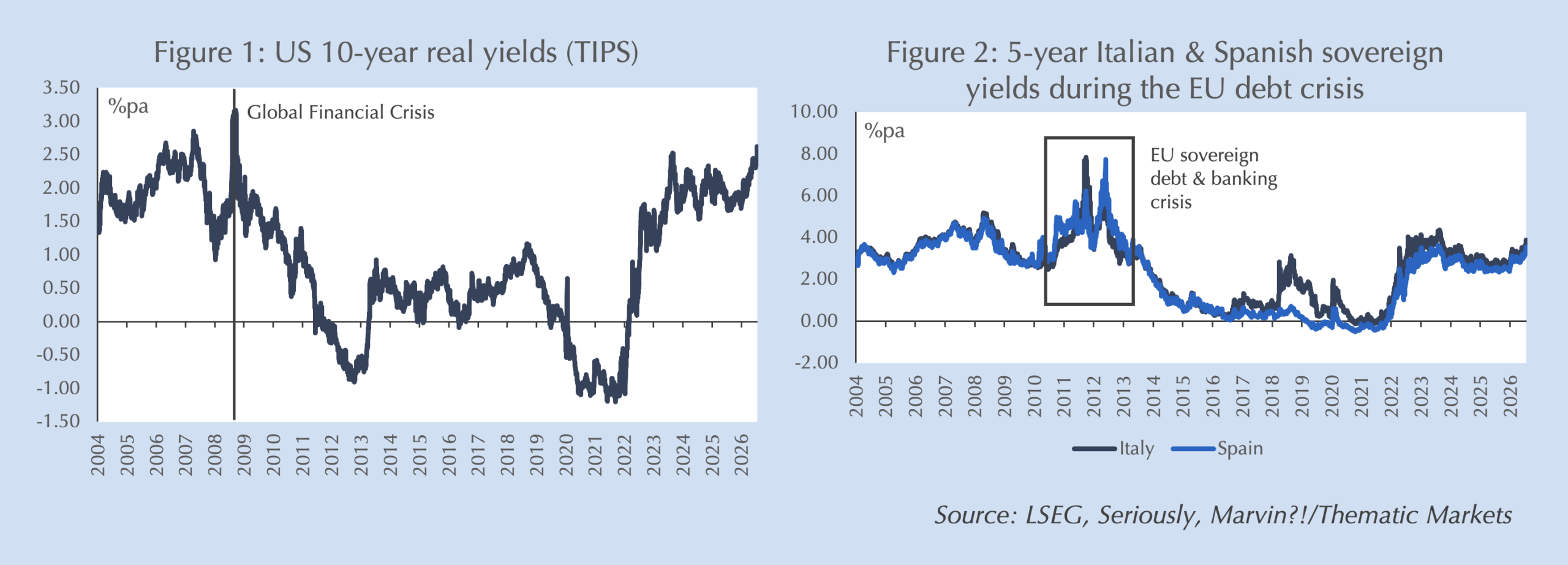
Hence, contrary to claims that the Fed has no choice but to inflate US debt away, that is actually the worst thing the Fed can do for US debt sustainability. That is why I have been so critical of the Fed’s long failure to return inflation to target. Inflation expectations are rising, and with them, longer-maturity real Treasury yields as markets question the Fed’s commitment to keeping inflation in check (Figure 1). However, we are far from crisis levels. The recent rise in yields — which has coincided with massive capex by AI firms and a drop in savings by Gulf oil states due to the Iran war — has only taken real yields back to their 2023 peak or what would have been considered “normal” before the Global Financial Crisis (Figure 1). Secretary Bessent’s acceleration of the Treasury’s (very small) buyback program that originated in the Biden Administration is just good debt management: retiring bonds trading at as little as 60¢ on the dollar and providing liquidity for long-term holders of US Treasuries. If you want to see what a bond market that actually fears default (or hyperinflation) looks like, look back to what happened to Italian and Spanish government yields during the EU sovereign debt crisis in 2011-12: they spiked to almost double their pre-crisis level in a matter of weeks.
Is US unsustainability approaching a tipping point?
That doesn’t mean that I don’t have any worries about US fiscal finances. The current trajectory is unsustainable and the world has become far more complicated. Throughout the 2010s, when clients asked whether US default or hyperinflation was a worry, I gave an unequivocal “no.” But the coincidence of wartime levels of public debt and budget deficits amid rising social division at home and serious geopolitical challenges abroad has changed my answer to a “definite maybe.” Given the deterioration in global security, significant increases in US defense expenditures are no longer a choice. But cutting domestic spending enough to both meet national security needs and balance the primary deficit would be challenging in any environment; in the current highly polarized polity, it will be far harder.
Which choice will Americans make?
But political economy suggests that Americans will find a way to return to debt sustainability, just as they did after the War of Independence, the Civil War, World War II, and the Cold War. As noted above, there is no escape from balancing the primary budget deficit. The only question is whether it will be managed or abruptly forced upon Americans by creditors. Given that, US household finances, demographics and cultural history suggest that Americans will choose managed fiscal consolidation. Whether through defined benefit plans or defined contributions, a majority of Americans hold a significant portion of their wealth in Treasuries, hence, default will not be popular. Nor will hyperinflation. The median US voter is now over 50, meaning that bond-owning retirees whose savings would be destroyed by it outnumber younger voters whose student loans and mortgages would benefit. Finally, as Carmen Reinhart and Ken Rogoff documented in their 800-year study of sovereign defaults, culture matters: some countries are serial defaulters, others rarely or never default.6[6] While Reinhart and Rogoff count FDR’s abandonment of gold convertibility in 1933 as a default (rather than the devaluation it was), the US has never failed to pay its debts.7[7]
Watch out for the midterms
The bottom line is that while the US debt is unsustainable, it has time to correct its path. Despite deep partisan divisions, I expect fiscal consolidation to become a major issue after the midterms. That doesn’t mean that the next Congress will take action, but the debate is likely to intensify going into the next presidential election. Time will tell if I’m right.











Comments are available to paid subscribers only.