

Populist-proofing central banks
Recent news reporting suggests that central banks are weatherproofing themselves against populist politicians. First came reports that Banque de France Governor François Villeroy de Galhau, a voting member of the Governing Council, would resign a year early, purportedly to prevent populist presidential frontrunner Jordan Bardella from naming his successor should he prevail in next year’s French elections.1[1] A week later the Financial Times reported that European Central Bank (ECB) President Christine Lagarde, too, intends to leave her post early, as might fellow Executive Board Members Philip Lane and Isabel Schnabel, moves that would allow current European leaders to choose their successors.2[2] Mme. Lagarde’s office denied the report.3[3] Across the Atlantic, Bloomberg reports that Federal Reserve Chairman Jerome Powell is “Trump-proofing” the Fed by encouraging Federal Open Market Committee (FOMC) members to dissent and, perhaps, by continuing in his role as governor even after his term as chairman ends in May.4[4] This follows a routine but unusually early vote in December by the Board of Governors to extend the terms of current Federal Reserve Bank presidents by five years.5[5]
Creeping politicization
While it is important to remember that the motives alleged in these reports are unconfirmed, they do fit a broader pattern of creeping politicization of central banks. Unprecedented asset purchases that were never expressly authorized by elected officials on either side of the Atlantic have resulted in hundreds of billions of dollars in losses at both the Fed and ECB.6[6] Both institutions have incorporated climate considerations into their policy or supervisory frameworks, again without direction from legislators.7[7] Further, the Fed opened the door to accusations of political tilt when it voted to cut rates by an inexplicable 50 basis points amid well-above target inflation and a booming economy two months before the 2024 election. More recently, the 180-degree turn in policy view of Chicago Fed President (and former Biden Administration economic advisor), Austan Goolsbee, from the FOMC’s most dovish member to a dissenting hawk at December’s meeting is every bit as suspicious as Governor Stephen Miran’s shift from pre-election hawk to post-election dove.
Protecting central banking for democracy…or from?
Central bankers – and their uncritical defenders – who deflect legitimate criticism by claiming “central bank independence” and wrapping themselves in a cloak of democratic legitimacy do themselves no favors. I do not care for the tone of President Trump’s rhetorical attacks on the Fed and am deeply concerned that criminal investigations into Chairman Powell and Fed Governor Lisa Cook could be intimidation tactics rather than legitimate law enforcement. But that does not mean that the institution or its appointed leadership are beyond accountability from democratically elected representatives for the worst inflation in four decades or from law enforcement requests for information related to credible allegations of misstatements under oath. As David Dredge noted in the latest episode of the Thematic Edge Podcast, the most recent Fed policy review reversed the policies adopted in the prior review without admission of error or an apology to the American people. The ECB has done no better in this regard.
Winning the battle and losing the war
The reported machinations at the Fed and ECB to insulate themselves from democratically elected governments, if true, may be a Pyrrhic victory. Populist leaders didn’t create the ire their voters have for these institutions: they’re riding it. Whether it is the Fed, the ECB, or the Bank of England, public confidence in these institutions has eroded significantly since the 2000s and plunged in recent years after each loosed the Furies of inflation through repeated policy errors.8[8] Central banks that fail to acknowledge, much less heed voters’ concerns, always lose the war as the Fed under Benjamin Strong found out following Franklin Delano Roosevelt’s election when it lost independence for two decades until the Fed-Treasury Accord. Add that to the list of reasons this year’s US midterm elections and the next round of European national elections in 2027 and 2028 will be critically important for markets.
Presidents on the front line
But the presidents most likely to come under fire next are not elected by voters, but by member banks of Federal Reserve Districts under the heavy influence of the Federal Reserve Chairman. This is why it was notable that the Board of Governors in Washington moved earlier than usual last December to extend the current presidents’ terms by another five years. As I explained previously, bringing along the Reserve Bank presidents will be critical to the Trump Administration’s banking deregulation goals, which are essential for Fed balance sheet reduction. If we are to believe the Bloomberg article cited above, they also are critical to Chairman Powell’s designs to Trump-proof the Fed by sowing dissents among them as he leaves the chairmanship after years of cultivating their subservience.
Groupthink? Or robust debate?
And therein lies the big question: both sides in this fight claim to want more dissent in discussions of monetary policy. Outgoing Chairman Powell celebrated December’s dissents as part of the best discussions “we’ve had in my 14 years at the Fed,”9[9] while incoming nominee for chairman, Kevin Warsh, critiques the current Fed for its “groupthink” and wants more “robust debate”10[10] and Treasury Secretary Scott Bessent criticized regional Fed presidents imported from New York as undermining the diversity of views the District Bank structure of the Fed was intended to generate.11[11]
Who’s right?
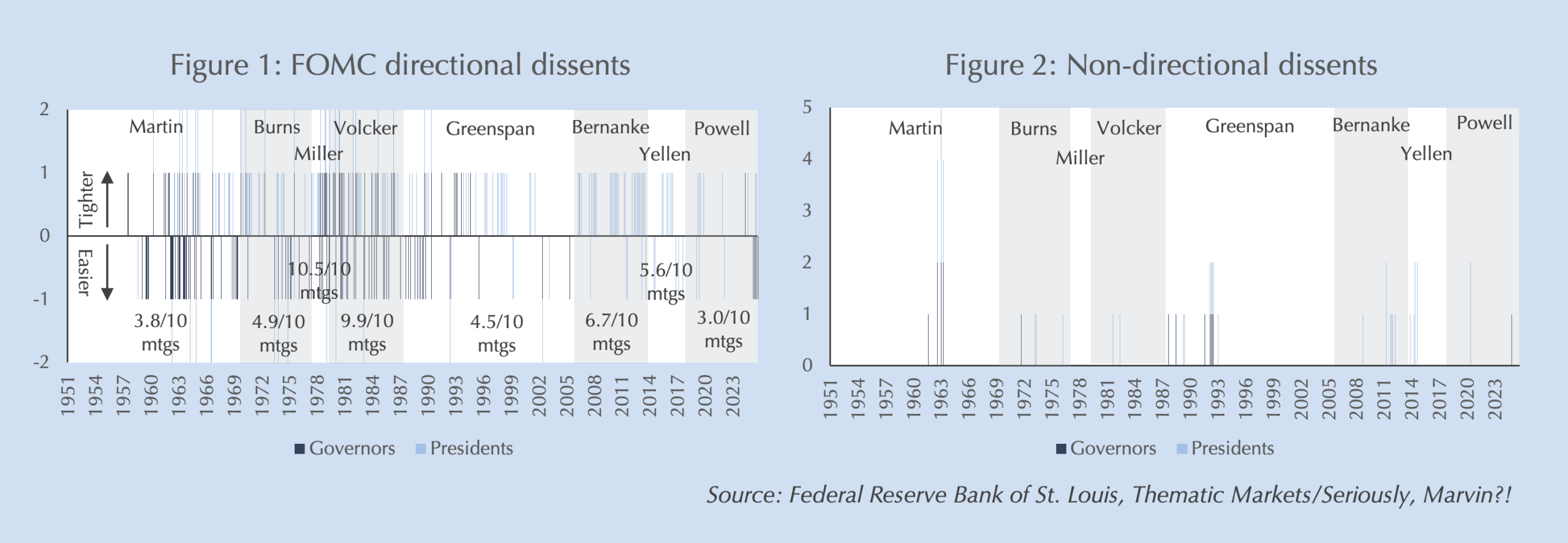
This begs the question of who to believe. We will have to wait to see from Mr. Warsh, though President Trump’s appointment of him, a long-time Fed critic, against market expectations for a dovish toady suggests (as I have maintained all along) that it is the Administration that is serious. We can, however, look back at Chairman Powell’s record. The irony of Mr. Powell’s alleged push for increasing dissent is that he holds the record among Fed chairmen for the lowest rate of dissent. Figure 1 presents the history of FOMC directional dissents among governors and presidents from the Fed-Treasury Accord in 1951 to the present, and Figure 2 shows the same history of dissents for other reasons. The tenures of the eight chairs over the period are indicated by shading, and at the bottom of Figure 1 I have tallied up the dissent rate per ten meetings for each chair. Mr. Powell easily has the lowest dissent rate, despite William McChesney Martin Jr. having none for the first seven years following the Accord and Alan Greenspan being a famously wily puppet master of the Committee (just ask former Vice Chair Alan Blinder).12[12]
Cookie cutter crew
I have long criticized the increasing groupthink at the Fed that is apparent in the declining record of dissents. Its cause, in my view, has been the replacement of independent, thoughtful people from a range of different professions with professional economists like me, all trained at the same top universities on the same models, with cookie-cutter credentials. This was first apparent among the governors, whose dissents began to peter out in the 1990s. Bank presidents, however, continued to dissent regularly (and mostly hawkishly) well into the last decade, reflecting Secretary Bessent’s point that the Reserve District structure was intended to create diversity. But over the last decade many of the Bank presidents have been replaced by economists brought up in the increasing groupthink of the Federal Reserve, or the “Gang of Four Money Marketeer” carpetbaggers from the New York financial community.13[13] This has eroded much of the independent thinking that brought about dissents and, in my view, reduced monetary policy errors.
Watch the presidents
In addition to the Bank presidents being critical to bank deregulation, this record of increasing group think is what puts a target on their back. While markets are focused on whether Chairman Powell will or will not give up his seat as governor when his term as chairman ends, or whether President Trump will be allowed to fire Governor Lisa Cook, I expect focus on the presidents, despite their recent reappointments by the Board, will pick up. If the President’s allies in Congress do well enough in the midterm elections, I wouldn’t be surprised to see discussion of reforming the Reserve Banks to require presidents to be from their Districts to also pick up steam. The presidents are the battleground.






Comments are available to paid subscribers only.