

True grit
Today is my father’s funeral. Just a few weeks ago, during our regular FaceTime, he complained of being weak. Days later he was diagnosed with terminal acute leukaemia. Despite being 94 years old, he was determined to fight. Yet the cancer progressed far too quickly. By the time I reached California, I had to lift him in and out of bed and chairs, and he could only speak with difficulty. Two days after I arrived his kidneys had failed him and he was denied chemotherapy. Though he could barely speak, he made clear that “no” was not an acceptable answer. It never was with him. Sadly, God had other plans. He was a man who defined what his generation of Americans would call “true grit.”
What I learned from my father
I’ve been surprised in recent podcast appearances by interviewers’ deep and sincere interest in how my father influenced my thinking. For that reason and my own catharsis, if you will indulge me, this week I’ll take a break from political economy and finance to write about my father and what he taught me. My fiancée, Joy Dafinone, has written a companion article on preparing for the death of a loved one: The Final Audit.
Ex hired killer and bomb maker
My Dad grew up a child of the Great Depression and World War II. Born in Ohio, he moved around during the war before settling down for high school in Wheeling, West Virginia where he met my mother. Known for speaking his mind, he led his class in demerits at the US Naval Academy. He commissioned into the newly formed US Air Force hoping to fly. Ever the romantic, he called my mother from his first duty station to move down to Houston to marry him. When bad eyesight kept him from flying – even after he tried to “sneak in” by becoming a navigator – he turned into a professional student, adding an MS and PhD in electrical engineering to his BS while still in the Air Force before retiring with the GI Bill to pursue a Juris Doctorate and MBA (he also managed to become a CPA). But he could make more as an experienced engineer, so with kids’ university bills piling up, he made his second career at the Lawrence Livermore National Laboratory, the premier US advanced weapons lab, in California, where I grew up. Typical of his sense of humor, based on his military and weapons lab service, he took to introducing himself as “an ex hired killer and bomb maker.”
Learning from our elders
I have never met a wiser or more admirable man than my father. It is his wisdom that I will miss most. Selfishly, my first thought and gripping fear upon learning of his diagnosis was “Who will I turn to for the questions no one else can answer?” Maybe I’ve developed “golden-age” glasses, but it strikes me that modern society has lost respect for how much our elders can teach us. That is a tragic loss. I always sought my father’s advice on questions great and small – especially the great ones – and even at 55 years old I remain amazed at how much I could still learn from him. Here are some of the lessons of that wisdom that I have distilled.
Honesty
Other than white lies of social nicety – despite his notorious bluntness – I cannot recall Dad ever lying. Nothing was more important to him than integrity. So strict was his moral code that he considered silent disagreement, especially in matters of importance, no different than lying. That cost him in his career. Honesty often isn’t appreciated in large organizations like the US military and government bureaucracy where he spent most of his professional life. But Dad never regretted his honesty, only his lack of political skills. Recounting a disagreement that likely cost him promotion of full-bird colonel, he noted that “I was right, the program never worked. I only regret not being more persuasive.” His honesty did accrue one important reward: deep and enduring trust from all who knew him.
True compassion
Many people talk about compassion, but my father lived it. As blunt talking as he was, his actions defined compassion. Ironically, given his cause of death, his whole adult life he donated blood monthly. For decades he visited the local prison to counsel and provide companionship to life-sentenced prisoners. He volunteered throughout the community, was a member of the city planning commission, the local school board, and the board of the county food bank.
Love
Perhaps most emblematic of his compassion was his care of my mother, who survives him. Their relationship could only be described as stereotypical of the 1954 America they married in: Mom cooked, cleaned and raised the kids, while Dad went to work. The only change when he retired was that his “work” became ever expanding community-service and church commitments. And yet, when in their late 80s, my Mom developed Alzheimer’s, my father – whose rigidity of routine was legendary – learned to cook, clean, manage the house, and take care of my mother with endearing compassion. His dogged determination to fight off cancer at the age of 94 was not for himself but for fear of leaving his wife of 71 years alone.
Engaged parenting
I was the last of five kids, seven years behind the others, who frequently remind me that Dad had mellowed to “kitty cat” status by the time I came around, yet no one would confuse his raising of me with today’s “gentle parenting.” His strictness was notorious among my friends. Dad was a self-described misanthrope who was happy to tell anyone who tried, politely but firmly, “I don’t do hugs.” Yet there was never any doubt of his love. He practiced active caring. Every night at dinner we were quizzed on school, activities and current events. He loved to argue and no matter what your view, you could count on him to take the other side to refine your thinking. He pushed us relentlessly, but he was always there to pick you up when you fell. If you had a setback, he never fed you sugary platitudes; he confidently affirmed your ability to set your own destiny and gave you practical advice on how to get back on track.
Tenacity
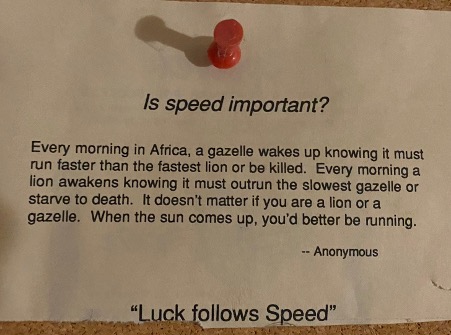
No where did Dad show his grit more than in his stubborn resolve to succeed at whatever he set his mind upon. As a child I was mortified when Dad would engage with my teachers, coaches, and school officials in pursuit of my interests, because the only acceptable “no’s” were no questions unposed and no stone unturned. Eventually, I learned to overcome my embarrassment and emulate his tenacity to my own benefit, and I hope to the benefit of my own children. As far back as I can remember, Dad had the above quote about gazelles and lions pinned to the bulletin board in his “den” (home office). When the going got tough, Dad often would simply tell me, “You’d better be running.”
Cut your own path
My father was an only child and perhaps because of that he always cut his own path. He was never afraid to go his own way, to zig when others zagged, or to speak his mind. He encouraged the same in us. “Stand up and be judged, Marvin, because they’ll judge you anyway, so you may as well be judged as you want to be.” I’m often asked where my natural-if-unintentional contrarianism comes from. I hadn’t realized it until his passing, but it now seems clear.
Unquenchable thirst for knowledge
There was never any doubt where my intellectual curiosity came from. With an unquenchable thirst for knowledge, Dad infused all his children with the need to understand the world around us through his example, word and deed. Receiving BS, MS, PhD, JD, and MBA degrees, plus being a CPA, his example was set unachievably high. If a medical school would have accepted him in retirement he would have an MD, too, but instead he took non-matriculated courses in biology, biostatistics, genetics, economics, Spanish, music, and art at the local community college. His den was filled both with every murder mystery written – his favorite “relaxation” reading – and with advanced textbooks in every subject. He would often tell me, “Books are the cheapest education you can get, so buy any that interest you.” As a kid, I remember being reluctantly dragged along to university bookstores in Berkeley (where I later studied) in which he would spend hours perusing books.
To fill a deep reservoir
His capacity to learn matched his appetite. Once, my parents visited me while I was working in Switzerland, and we visited a museum across the border in France. While I knew that he had studied German and Latin at the Naval Academy, I was shocked to see him reading without difficulty the detailed descriptions of the exhibits in French. “You know French?!” I asked in surprise. “I needed to translate a scientific paper from French for my PhD, so I taught myself.” Dumbfounded I asked how long that took him: “A week or two.”
Embracing change
Despite growing up so long ago that he referred to freezers as “the ice box,” because that’s literally what he grew up with, he adopted AI immediately to help him code “fun” projects he was working on (just a few months ago he was coding his own analyses of money and inflation to challenge me on my research). His embrace of new technology was a constant in his life. We got our first home computer – a NorthStar Z80 in 1977 and a VHS video recorder that same year. He bought me my first laptop in 1990 and I can still remember taking lecture notes on it at UC Berkeley for the first time. The professor and the whole of the 300-person lecture hall fell silent and turned to gawk at the novelty of someone typing in class.
Exercise
My last FaceTime with my father was no different from any other in one respect: “Are you exercising?” Dad always encouraged us to exercise both for physical and mental health. As always, he led by example. Even at 94, Dad was exercising for two hours, three or four days per week (despite cooking, cleaning and taking care of my 91-year-old mother with dementia).
Faith
I have always been in awe of, and jealous of my father’s deep faith that he came to of his own volition. Dad’s father was an atheist and his mother was a non-practicing Christian, but Dad went to church on his own. He later admitted to me that it was to meet girls, but he developed from it an unshakeable faith. His Christianity, as you might expect, was the active variety: deeply involved in church activities and charity. Dad wasn’t particularly evangelical – except with his children and grandchildren – but, as with any other topic else, he would eagerly engage in theological debates with clergy and laymen alike. I am sure that he is arguing with God now. I struggle with my own faith, but I never cease to be amused when someone tries to tell me that faith is a palliative for the uneducated. “Let me introduce you to my father…”
Family
Despite being an only child, family was paramount to Dad. There was nothing he wouldn’t do for his family. He never left a doubt with his five children, 13 grandchildren, three great grandchildren, and their respective spouses that his home was their home. His go-to solution for any problem in our lives – at all ages – was that we should move back in with him and Mom until things stabilized. When I brought my stepdaughters – his “granddaughters” he corrected me – from London to meet him for the first time, at his strong insistence, and took my younger one to visit my alma mater, UC Berkeley, his response was “Yes, you should apply! And you can live with us!”
Joie de vivre
While Dad liked to portray himself as a curmudgeon, he was full of an irrepressible joy of life and humor. No matter how bad things might become, he could always find something to get excited about. His excitement was the infectious variety. Whether it was celebrating one of his children’s accomplishments or something as simple as gedunks (sweets in Midshipman-speak), he would do a little fist pump and shout out “Outstanding!” For a man who was so deeply earnest, intellectual, serious, and religious, he never let life get too serious. He could find humor and something to love in everything. If I had any doubt, his ability to bring joy and laughter to every situation was a common theme underlying the eulogies of speaker after speaker at his vigil service last night.
He would probably disagree with me on principle, but I am going to miss him.
If you found this article “outstanding,” be like Dad: be honest, practice true compassion in your community, learn something new, exercise, find something to believe in, and love your family.









Comments are available to paid subscribers only.