

Missing US jobs: The critical puzzle
The contradiction between slowing nonfarm payroll (NFP) growth and other hard data showing accelerating US growth is the critical puzzle in the economy. If the Fed is correct that slackening NFP gains, usually a lagging indicator, are an early warning of an economic slowdown, earnings estimates and stock prices are too high. But if it instead reflects mismeasurement and restrained immigration as I’ve shown in my research at Thematic Markets, then the Fed is making a serious policy error and bond markets are grossly mispriced.
AI fly in the ointment
The fly in the ointment of my theory is the gentle rise in the unemployment rate from its 54-year low of 3.4% in April 2023 to 4.3%. It could reflect mismeasurement. The unemployment rate is derived from the Bureau of Labor Statistics’ Household Survey and may suffer from the same “trust” bias in political polling that has misled others (but not me) in recent elections. More generally, that may explain the steady divergence between survey and “hard” data. But I think it more likely reflects a rise in the structural rate of unemployment due to a mismatch between worker skills and those demanded by firms that has been exposed by generative artificial intelligence (AI) and large language models (LLMs). If so, it isn’t a coincidence that the cycle low in the unemployment rate occurred just after ChatGPT was introduced.
Structural unemployment and NAIRU
Structural unemployment is joblessness caused by frictions in matching workers to firms. Finding a job takes time – sifting through LinkedIn, interviewing, et cetera – that creates a base level of unemployment even in a strong job market. Structural unemployment underlies the economic concept of “NAIRU,” or the Non-Accelerating Inflation Rate of Unemployment. Below that NAIRU, inflation accelerates as firms bid workers away with ever-higher wages; above it, household incomes fall, dampening aggregate demand and inflation. NAIRU is not observable and it appears to vary: in the 1960s it was thought to be 3-4%; from the 1970s through the ‘90s it was thought to be 5-6%; and recent experience suggests it might again have fallen to around 4%. Importantly, monetary policy cannot change NAIRU, only react to it.
Rising structural frictions?
Job search is not the only labor-market friction. Mismatched skills also can raise NAIRU. If all the new jobs are for engineers but all the unemployed workers are poets, it will take time for either the firms to figure out how to use poets or for the poets to learn to solve Fourier transforms. Again, this is a problem of time, not monetary policy. My theory is that the advent of generative AI has rapidly exposed a long-gestating mismatch between semi-skilled university graduates and the skilled work demanded by Localizationand geopolitical realities, raising the structural level of unemployment.
Misspent youth
This is bound to shock and offend some readers, but the US has too many university graduates of diminishing quality, trained in the wrong subjects. The sad truth is that most university degrees are awarded in subjects that provide few usable skills beyond enhanced literacy. Worse, the returns to even “skills” degrees are strongly correlated with ability, meaning that as student intake has expanded it has necessarily lowered average and marginal accretion of value. Simply put, we have too many poets and not enough engineers, and both the average and marginal quality of each have fallen.
Everyone can do it! Even coalminers!
Since its abuse by Social Darwinists, it has become taboo to talk about the role of ability in life outcomes, but whether due to nature or nurture, ability is not evenly distributed. As a society we can accept that not everyone will be able to run as fast as Usain Bolt, swing a baseball bat like Shohei Ohtani, or hit a tennis ball like Novak Djokovic, but we refuse to acknowledge, much less discuss that not everyone will be able to solve abstract math problems like Cédric Villiani, develop a vaccine like Sarah Gilbert, or design a neural network like Andrej Karpathy. Indeed, we promote the opposite as a socio-political myth, i.e. that everyone will benefit equally from a university education. Never mind that the available evidence strongly contradicts that myth,11 it now is so pervasive in many Western societies that former President Joe Biden once chid American coalminers that their failure to go to college was their own bad life choice.22
Socio-economic consequences
This myth has been disastrous for many young people, leaving them saddled with debt but lacking the skills to pay them, and often even without a diploma.33 More relevant to my hypothesis, it likely has played a critical role in raising structural unemployment. Too few of the degrees awarded by universities deliver valued skills and those that do have been devalued by expanded access to less able students and grade inflation.
19th century French poetry
The first of those problems is well illustrated by one of my favorite scenes from the movie Groundhog Day: when Rita (Andie MacDowell) tells Phil (Bill Murray) that she studied “19th century French poetry” at Bryn Mawr, he blurts out what many people think to themselves: “What a waste of time!” It’s not that critical analysis and appreciation of French poetry have no place in our society, it’s that the number of people who can be gainfully employed to study it is vanishingly small. For the rest, as with most humanities and social sciences students, their degrees add little skill beyond improved literacy and perhaps critical reasoning. Unfortunately, those attributes fall in the category of “semi-skilled” rather than “skilled.” This is reflected in humanities graduates’ wages and employment rates, which tend to be well below those with degrees in Science, Technology, Engineering and Mathematics (STEM),44 who comprise only about a fifth of university graduates.55
When everyone’s special, no one is
Now that I’ve angered all the social sciences, let me deflate the STEM majors: yes, your skills are in greater demand, but they’ve been deeply devalued by expansion of access and grade inflation. As I noted above, there is strong evidence that the value of university training – even for STEM – is significantly increasing in innate ability. As the pool of entrants to university expanded from about a quarter of 18- to 24-year-old Americans in 1970 to roughly two-fifths over the last decade, both the average and marginal abilities of STEM graduates declined with proportionate effect on the value of their skills.66
Everyone gets an A!
To make matters worse the average grades – even within the same universities – were sharply inflated. For instance, only 24% of Harvard engineering students received As in 2003, but by 2021 60% did (for arts and humanities the proportions were 30% and 73% respectively).77 Nor is this unique to the US: in 1985 only 7% of British university graduates received a first class degree, with a further 20% getting an upper second class degree (2:1); today the proportions are 29.6% and 48% respectively.88 At Imperial College, the top-ranked sciences university in the UK, 48.5% of graduates receive a first!99
Good while it lasted
The extent of the West’s misallocation of labor force training to university studies was masked for years by the effects of globalization, including China’s intentional policies to deindustrialize its strategic competitors in the process of climbing the skills ladder itself. As a flood of cheap traded goods increased the relative value of non-traded goods – e.g. services that can’t be traded across borders – employment demand rose for “soft skills” like enhanced literacy and communications. Good paying jobs as paralegals, administrative and human resource managers, copy editors, graphic artists, et cetera beckoned. But then the world began to change.
The times are a-changin’
Both technology and geopolitics shifted labor demand. Automated Localization began to return manufacturing to the US. That process was accelerated in the last several years by the national-security imperative to recreate domestic industrial capacity, accelerating the Localization process. Increasingly, it was skilled but non-university-educated workers that were in demand: unfilled jobs for electricians, pipefitters and welders began to expand rapidly, with wages that rival or exceed many university degree holders, particularly those from the humanities.1010
Throwing gasoline on the fire
The mismatch between rising demand for skilled tradespersons and a workforce of semi-skilled university graduates was accelerated sharply by generative AI and LLMs. The jobs most exposed to being replaced or consolidated by generative AI are exactly those that had previously been filled by expanding cohorts of humanities, social sciences, communications, and business administration degree holders, while the jobs most complemented by AI are skilled trades (at least until Elon Musk replaces them with Optimus robots).1111 Even many STEM trained workers are exposed to job consolidation as Copilot now codes for even coal miners.1212 New graduates lacking the “je-ne-sais-quoi” experience that AI can’t yet master are particularly exposed and anecdotes abound of their “jobpocalypse.”1313 Even Thematic Markets will soon be unveiling a “Mini Marvin” GPT to answer your questions based on my research.
Solving the US unemployment mystery?
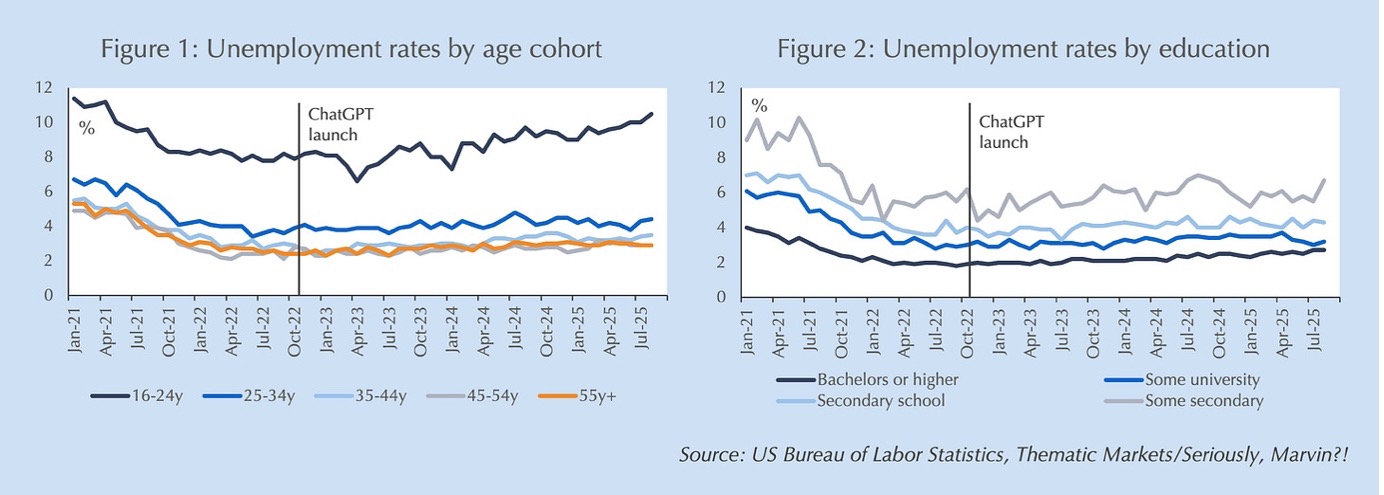
But does this explain the rise in US unemployment? At first glance, it isn’t obvious. While there has been a more pronounced rise in the unemployment rate for 16- to 24-year-old workers than for older cohorts (Figure 1), the rise in the unemployment rate for university graduates is not noticeably worse than for lesser-educated workers (Figure 2). But there are two problems with comparing unemployment rates only.
Adjusting for labor shares
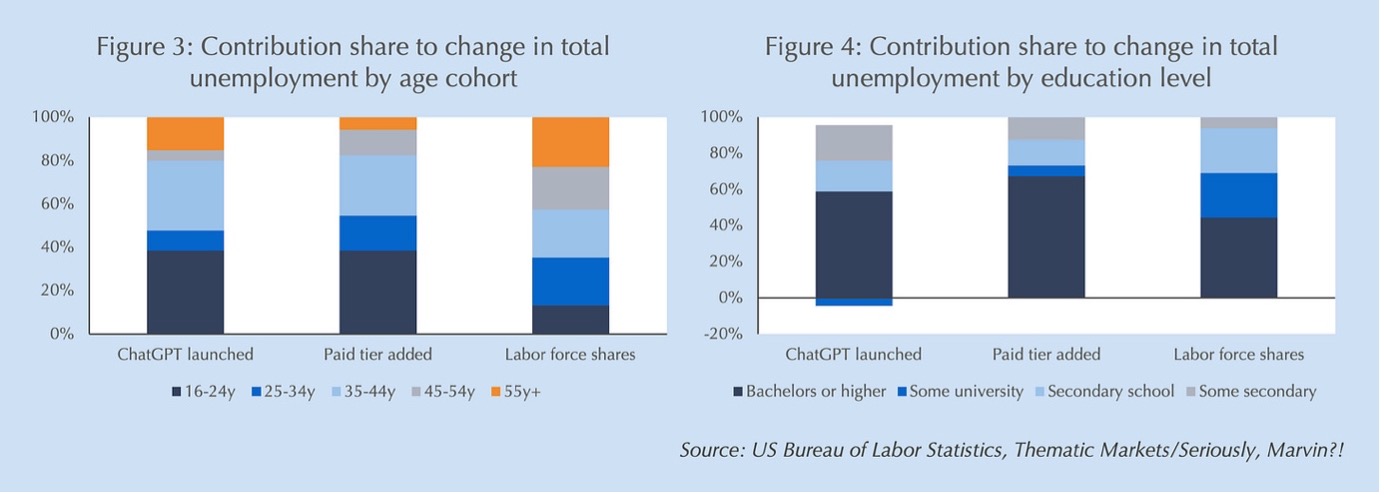
First, the effect of each of these groups on total employment is a function of their labor-force shares. A small change in the unemployment rate of university graduates will have 8.5 times the effect on aggregate unemployment as a similar change in high school dropouts because of their differing labor force shares (45% versus 5.8%). Figures 3 and 4 show instead the proportion of the total rise in US employment attributable to each age cohort and educational-attainment category, respectively, both since ChatGPT’s free launch in November 2022 and since the introduction of a paid tier in March 2023. For comparison, the third column of each chart shows the population proportions of each group. Consistent with my skills mismatch thesis both younger workers and university graduates are responsible for a disproportionate share of the rise in total unemployment. Unemployment for workers with “some university,” which would include some technical/craftsmen degrees, has actually fallen since ChatGPT was introduced.
Exiting the workforce to retrain
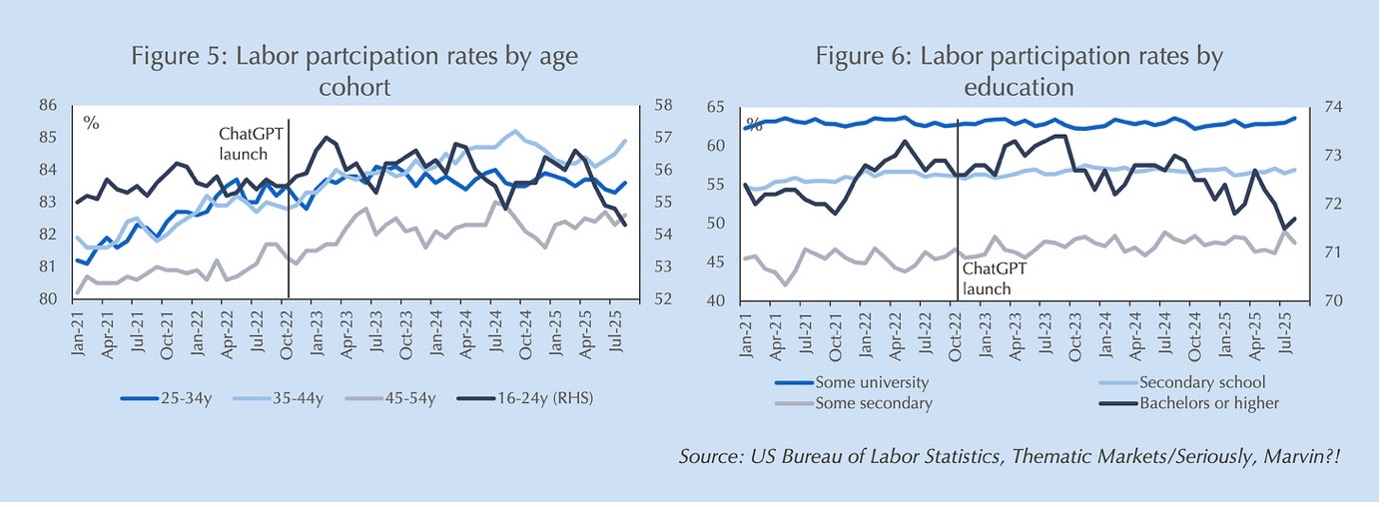
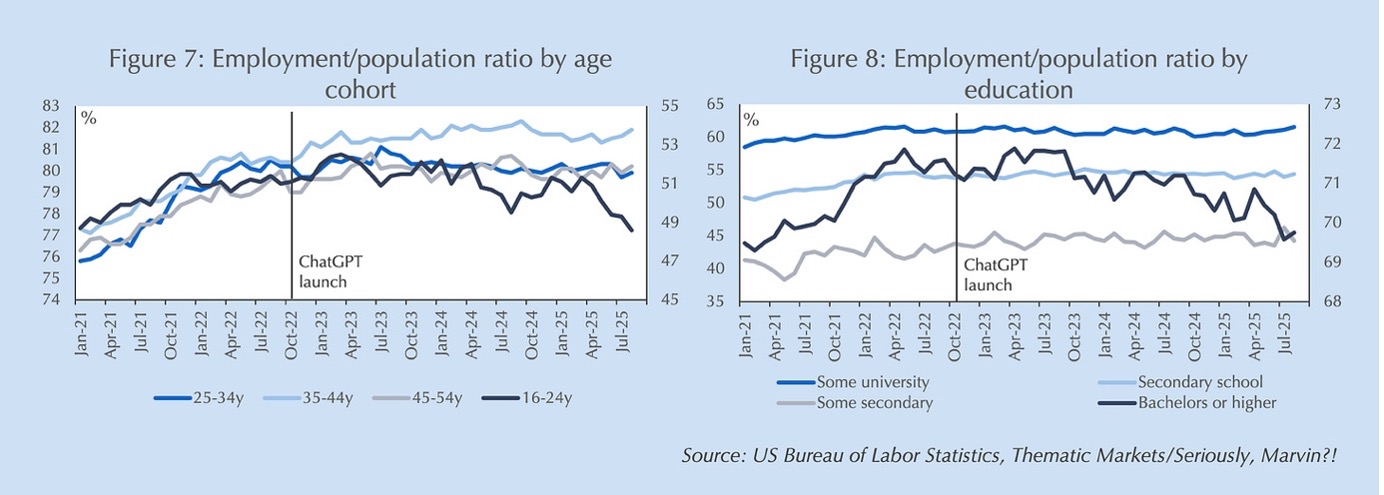
The second issue is that workers are counted as unemployed only if they are in the labor force. If they withdraw to return to university for another degree, they are not counted as unemployed. Figure 5 shows that indeed, the only age cohorts with declining labor participation are 16-24 year olds and, to a lesser extent, 25-34 year olds (over 55s, nearing retirement, also have registered a slight decline in participation). Figure 6 ties this directly to education level: only university graduates have reduced their labor participation rate since the launch of ChatGPT. The same phenomena are apparent in employment-to-population ratios: it is again the younger age cohorts (Figure 7) and university educated (Figure 8) that are witnessing a fall in employment shares.
How high and how long
The above strongly suggests that a skills mismatch is contributing to a rise in structural unemployment, implying a higher NAIRU, and that the Fed is making a serious policy error. But left unanswered are how high NAIRU is moving and how long it will take for the mismatch to alleviate. As I noted at the start, NAIRU is known only by its signs, so we will only know where it is when inflation begins to slow significantly. Given the “datapocalypse” in Washington, DC and the Fed’s policy errors, that may take a while. There are more hopeful signs on the retraining front, even though it is likely to take a decade and perhaps a generation: university enrolment as a share of 18 to 24 year olds peaked in 2011 and has been edging lower, while there are signs that Gen Z is becoming “the toolbelt generation.”14










Comments are available to paid subscribers only.