Keystone cops

Staggering governing incompetence will have market consequences

No, it isn’t April Fools Day…

You could be forgiven for thinking it was April (Fools Day) or that some prankster had replaced your FT or WSJwith The Onion or Babylon Bee last week. The Sunday before last, in broad daylight while the museum was open, four masked burglars drove a truck with an extendable ladder alongside the Louvre in Paris, slowly extended the ladder to a second-floor balcony to enter the museum via a window that they breached with power tools, smashed display cases to seize irreplaceable French crown jewels worth an estimated €88 million, scampered back down the ladder, and then absconded on motor scooters.11

It’s just another accidental prisoner release

Not to be outdone, British authorities twice in the days that followed proved themselves even more incompetent. Three days after the Louvre humiliation, the first “one-in-one-out” asylum seeker returned to France under a deal negotiated between Prime Minister Sir Keir Starmer and President Emmanuel Macron, snuck back into the UK less than a month after deportation.22 A few days later, British prison authorities accidentally released the UK’s most notorious sexual predator and asylum seeker, whose assault of a teenager had led to sustained civil unrest this past summer.33 Adding to the Keystone coppery, after Hadush Kebatu had spent 90 minutes in front of the prison soliciting passersby for directions, a helpful Bobby pointed him to the train station.44 And this was no one-off mistake: as a result of the cockup, Britons learned that Mr. Kebatu’s release was one of 262 accidental prisoner releases in the last year!55

Farcical façade has real ramifications

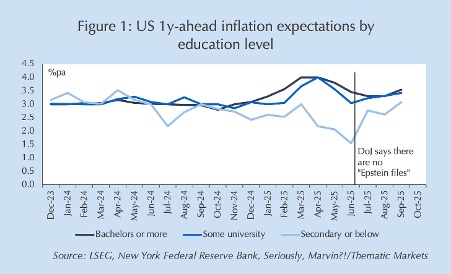
These stories may seem farcical fodder for tabloid covers and TikTok memes, but I expect them to have significant political and market consequences. If that seems far-fetched, recall that earlier this year I forecast that the Trump Administration’s non-release of the “Epstein files” risked reigniting inflationby undermining his voters’ faith in his ability to bring down inflation.66 Yet, as is often the case with my predictions – you have subscribed, haven’t you? – exactly that happened as shown by the jump in lower-education consumers’ inflation expectations shown in Figure 1 (note that their expectations had moved in the opposite direction to educated consumers who were more likely to vote for former Vice President Harris). Sometimes, things that seem inconsequential to the cognoscenti become totems for the masses.
Cutting to the core of the Politics of Rage

The Epstein backpedal was significant because it was a breach of covenant with Trump voters. The Anglo-Gallic farces are instead serious because they cut to the core issues that have fueled rise of the Politics of Rage, the four-decade-old voter rebellion against their betters.77 The critical driver of “populism,” as it is more commonly called, is ordinary voters’ sense of disenfranchisement due to the divergence in interests between them and the elites they elect to represent them. The two greatest elite-commoner divides across Western countries are immigration and sovereignty. Elites value cheap labor, frictionless business and globetrotting; ordinary citizens resent the resultant wage suppression, housing and healthcare pressures, and cheapening of their “first-world” citizenship.

Lingering reminders

Last week’s embarrassments are likely to linger in the public consciousness as reminders of those deeper tensions. The demonstrated failure of Sir Keir’s “one-in-one-out” policy and the accidental release of Hadush Kebatu the same week are damning indictments of UK asylum policy – adopted from EU law after Brexit – that has inflamed many Britons. The reason for Mr. Kebatu’s asylum claim remains unknown, but after being sentenced to a year in prison in the UK for sexually assaulting a 14-yearold girl and another woman within a week of entering the UK, Mr. Kebatu apparently felt safe enough to request that he instead be return to Ethiopia (a request that was granted; Mr. Kebatu was due to be deported when he was mistakenly released).88

Of true “exorbitant privilege”

The robbery of French national treasures is not directly related to French immigration policy, but the fact that at least one of the suspects is a dual Algerian-French national is likely to turn the scandal into an immigration issue.99 More pointedly, the Louvre heist serves as reminder of elites’ lack of accountability: Even after offering her resignation, the museum director faces no consequences for the spectacular security failure at the world’s most-visited museum despite admitting that security upgrades whose need was well known were delayed, that there were no security cameras in the area, and that while alarms supposedly worked, no one responded within the seven minutes taken by the burglars despite the museum being open to the public.1010

And a history of incompetence

Perhaps more pertinent, last week’s debacles were a stark reminder to voters of the staggering record of incompetence in recent decades by Western leaders from both the center left and center right. The list of their failures long and damning: costly inconclusive or losing wars in Afghanistan, Iraq, Libya, Serbia, Syria, and Ukraine, waves of immigration following each, the Global Financial and European Monetary and Banking Crises, lockdowns that yielded no improvement in mortality rates relative to jurisdictions that didn’t implement them but resulted in far worse social and economic costs, and a Brexit execution that generated no tangible economic gains but adopted EU laws and increased immigration, despite those two issues being the first and second most cited reasons for Leavers’ votes. This litany of failure has shattered trust in government across the West.

Making mockery great again

Perhaps most damaging for center parties in Europe, not just Sir Keir and President Macron, is that it opens them to general mockery rather than usual partisan variety. Even Labour and Renaissance diehards will feel foolish defending their leaders from due ridicule in pubs and brasseries across the UK and France. But it is unlikely to stop at the Rhein and Pyrenees: their center-left/right partners across Europe will be opened to the same popular jeering due to their own embarrassing failures this year, including:

  • German Chancellor Friedrich Merz’s historic failure to be elected on the Bundestag’s first vote,1111 nearly collapsing his two-month-old coalition with his endorsement of a Constitutional Court nominee whose views are at odds with his own party and is accused of plagiarism,1212 and most substantively breaking his campaign pledge on German’s “debt brake” to boost defense spending but arguably hobbling its efficacy by agreeing that much of the exempted spending must aim to achieve “climate neutrality by 2045.”1313
  • Spanish Prime Minister Pedro Sanchez was embroiled in a corruption scandal that involved his most senior deputies1414 and oversaw the worst blackout in European history after the Iberian grid failed for three days due to overreliance on solar electricity generation without sufficient infrastructure to offset its fluctuations, a fact that he continues to deny.1515
  • The European Commission admitted that it had misused grants from a €5.4 billion environmental fund to lobby EU member governments,1616 and more substantively suffered the perceived humiliation (the actual deal was not as bad) of bending to President Donald Trump’s trade demands after a half year of tough but hollow threats.1717

Et tu, Brut?

Populist leaders, too – notably President Trump – have had their fair share of embarrassing displays of incompetence in the last year, from including uninhabited, non-independent islands (Heard and McDonald Islands) on his “Liberation Day” tariff list, to announcing H1-B visa changes late on a Friday night. But there is a big difference between embarrassing rollouts and failing policies. Like his policies or not, except for the Epstein files that remain a thorn in his side, President Trump is largely delivering on his election promises with better-than-expected results:

One can site similar achievements for Prime Minister Giorgia Meloni of Italy, including a 3.4% fiscal consolidation that is one of the largest in OECD history (and yet still resulted in GDP growth better than Germany). Or, Javier Milei’s economic growth and budget balancing success in Argentina that has resulted in a major surprise electoral victory over the weekend. The point is, that populists across the world are delivering on their promises and attracting voters with competent governance at a time when the traditional center-left/right parties are making themselves the butt of jokes (and objects of voter ire).

Performance-based legitimacy

The greatest political scientist of the last century (ever?), Samuel Huntington, described almost 60 years ago a formula for governing legitimacy that has proved immensely successful with autocrats in Asia and the Middle East: “performance(-based) legitimacy.”2020 By meeting citizens’ needs for security, stability and sustained income growth, autocrats in these countries have been able to not only maintain power, but popularity with their citizenry. Mr. Huntington theorized that democratically elected governments did not need to meet as high a threshold for competence because their legitimacy derived from election by their citizenry. However, he did not tackle the question of a minimum bound before citizens throw out their elected representatives. Europe’s center-left/right governments appear to be testing that boundary.

Populist wave?

Italy, Belgium, Czech, Hungary, and Slovakia all now are led by right-wing populist governments, while the governments of Denmark, Finland, Sweden, and Switzerland, all either include populist parties or rely on their confidence and support (additionally, the caretaker government of the Netherlands was installed by the populist Freedom Party who is again leading in the polls for this week’s election). Populist parties continue to make gains across Europe, both in polling and in recent elections in Austria, Norway and Portugal.2123

The big three economies most under threat

While the big economies of France, Germany, and the United Kingdom do not face scheduled elections until 2029, all three governments are unstable, suffering from crises of legitimacy, and are behind in the polls. Friedrich Merz’s coalition government seems to lurch from one crisis to another despite being less than six months old and has fallen narrowly behind Alternative für Deutschland in polling. President Macron’s 2024 gamble to call early legislative elections and coordinate tactical voting against the populist National Rally (RN) party backfired, resulting in an ungovernable parliament and a succession of failed governments. Even some allies of President Macron are now suggesting he leave office early and call elections to resolve the crisis, with RN holding a significant lead over other parties.2222

Watch for the backbenchers’ knives

But it is Sir Keir in Westminster that is in the most immediate danger. For much of this year polling shows the new populist Reform Party winning an absolute majority in an early election – potentially the largest single-party majority in British history – with the traditional ruling parties, Labour and the Conservatives, falling to a distant third and fifth!2323 But that is not Sir Keir’s imminent danger. As I warned before the 2024 election, the combination of Labour’s large majority, popular dissatisfaction with them – their electoral victory resulted from a vote against the Conservatives rather than for Labour – and Sir Keir’s ties to the Blairite wing of the party run the risk of an internal coup before the 2029 election. The writing appears on the wall for Sir Keir after this week’s historic by-election loss of a seat that Labour had held for a century in Wales and the election of one of his foes as Deputy Leader of the party.2424 A popular, young and much further left mayor of Manchester, Andy Burnham, is apparently already being urged to challenge Sir Keir for the premiership.2525

Are markets prepared?

Europe is already struggling with anæmic economic growth, persistently high inflation, high energy costs, serious debt sustainability questions, and rising needs for defense expenditures with a war on its doorstep, yet markets seem remarkably complacent. I’m commonly asked if UK gilts look attractive at these levels (no) and EURUSD risk reversals – the premium for call options over put options – are positive from 1 month through 5 years (insane). The UK is at serious risk of a sharp turn to the left that likely will have significantly negative implications for its currency and its relations with President Trump (who recently came to visit bearing £100 billion in gifts that he might call back). France, with the least sustainable debt in Europe, is ungovernable and potentially on the verge of early elections. Even Germany, formerly Europe’s Atlas but more recently its sick man, appears at risk of political instability. The only potential good news is that the record of European populist governments – if they get a chance to govern – is for greater fiscal responsibility than their traditional centrist peers. Clearly, I meant the question in the subtitle rhetorically.

Epilogue: Jackson, Sulla or Cæsar?

I suppose that I can’t cast Donald Trump as delivering Huntington’s “performance-based legitimacy” without returning to the question I posed last November in my preview of his second term (free at Thematic Markets): will he prove to be the return of Andrew JacksonSulla or Cæsar? With nine months of evidence, I still lean towards Jackson. Indeed, I would suggest that all his behavior and policies strongly align with the seventh US president. Rather than performance-based legitimacy, he seems to be delivering what European center-left/right parties cannot: performance-based electability. But Sulla or Cæsar remain possibilities; only time will tell.
1

Paris prosecutor says stolen Louvre jewels worth an estimated $102 million,” Sylvie Corbet, Associated Press, 21 October 2025; “Manhunt underway for 4 suspects after heist of ‘priceless’ jewelry at Louvre in Paris,” Aicha El Hammar Castano, Kevin Shalvey & Bill Hutchinson, ABC News, 20 October 2025; “Thieves steal eight objects from Louvre in daring daytime heist,” France 24, 19 October 2025; and “Louvre heist: hunt on for thieves after eight ‘priceless’ jewellery pieces stolen,” Angelique Chrisafis, The Guardian, 19 October 2025.

2

‘One in, one out’ migrant farce as man sent to France comes straight back,” Ella Bennett, LBC, 22 October 2025; “Asylum seeker sent back to France under … ‘one in, one out’ scheme returns to Britain in small boat,” Millie Cooke & Kate Devlin, The Independent, 22 October 2025.

3

Manhunt after jailed Epping hotel asylum seeker mistakenly released,” André Rhoden-Paul, Shivani Chaudhari & Ellena Cruse, BBC, 24 October 2025.

4

Kebatu manhunt latest: Family of girl assaulted by sex offender feel ‘massively let down and infuriated’ by his mistaken release,” Sky News, 26 October 2025; and “Met police take over search for Epping sex offender after London sighting – as it happened,” The Guardian, 26 October 2025.

5

Ibid.

6

And sadly, only one person got the joke/allusion in my cover image to that article! Hats off to Altaff Kassam who not only got that one but was one of only three people that recognized that every subtitle in my original Localization research, “Rethinking Emerging Markets,” was either an REM song or album.

7

“The Politics of Rage,” Marvin Barth, Thinking Macro, Barclays Research, 16 October 2016; available upon request to paid subscribers of Thematic Markets.

8

Epping hotel asylum seeker jailed after sexually assaulting woman and 14-year-old girl,” Sky News, 23 September 2025; and “Asylum seeker at centre of Essex hotel protests jailed for 12 months,” Ben Quinn & Rajeev Syal, The Guardian, 23 September 2025.

9

Louvre heist: What we know about the two arrested suspects,” Soren Seelow, Le Monde, 26 October 2025.

10

Louvre director acknowledges failure after jewel heist and says she offered to resign,” Thomas Adamson & Sylvie Corbet, Associated Press, 22 October 2025.

11

Merz fails to be elected Germany’s chancellor in first parliament vote,” Al Jazeera, 6 May 2025.

12

Germany’s coalition hits severe rough patch over court nominee,” Daily Sabah/Deutsche Presse-Agentur, 11 July 2025.

13

Grundgesetz für die Bundesrepublik Deutschland, Art 143h, Bundesministerium der Justiz und für Verbrauchershutz, Federal Republic of Germany; “Q&A – Germany’s €500bln special fund for infrastructure and climate neutrality,” Benjamin Wehrmann, Clean Energy Wire, 15 October 2025; “Merz reaches deal on infrastructure fund by promising Greens €100 bln for climate action,” Benjamin Wehrmann, Clean Energy Wire, 14 March 2025; and “German parties agree deal to loosen debt limit, expand defense spending as Europe called to do more,” David McHugh & Stephanie Dazio, Associated Press, 14 March 2025.

14

Spanish PM Sanchez resists call for elections, promises overhaul over graft case,” David Latona, Inti Landauro & Emma Pinedo, Reuters, 13 June 2025.

15

Fessing up,” Doomberg (Substack), 28 August 2025; and “The Grid Needs Inertia, Not Spin,” The Brawl Street Journal (Substack), 4 May 2025.

16

EC admits ‘misuse’ and ‘undue lobbying activities’ in grant awards,” Carl Deconinck, Brussels Signal, 2 April 2025.

17

European feel ‘humiliated’ by Trump trade deal: Survey,” Anadolu Agency, 9 September 2025; “Europe Signs Up for Its Century of Humiliation,” Ingar Solty, Jacobin, 29 July 2025; and “This trade deal is the EU’s greatest humiliation since Britain voted to Leave,” Kwasi Kwarteng, The Telegraph/Yahoo!News, 28 July 2025.

18

How many illegal crossings are attempted at the US-Mexico border each month?” USAFacts, as of 27 October 2025.

19

Federal Surge, 9/1/2025 Data Report, DC Index Crimes, MPD Arrests, Calls for Service & Firearms Recoveries, Metropolitan Police, District of Columbia, 1 September 2025; and “D.C. mayor praises federal surge, angering residents and pleasing Trump,” Olivia George & Rachael Siegel, The Washington Post, 28 August 2025.

20

Political Order in Changing Societies, Samuel P. Huntington, Yale University Press, 1968.

21

Poll of Polls,” Politico.eu, as of 27 October 2025.

22

Macron’s political isolation deepens as allies abandon him, outgoing PM holds last-ditch talks,” France24, 7 October 2025; and “Macron under pressure to call snap parliamentary elections or resign,” Jon Henley, The Guardian, 7 October 2025.

23

Is Reform UK on course for the ‘biggest landslide’ in history?” Hannah Smith, Full Fact, 16 October 2025.

24

Lucy Powell wins Labour deputy leadership election,” Harry Taylor, The Guardian, 25 October 2025; and “Labour suffers seismic by-election defeat to Plaid Cymru in Wales,” Jim Pickard, Financial Times, 24 October 2025.

25

Burnham says MPs are privately urging him to challenge Starmer for Labour leadership,” Eleni Courea, The Guardian, 25 September 2025; and “Andy Burnham launches thinly veiled bid to replace Keir Starmer,” George Parker & Jennifer Williams, Financial Times, 24 September 2025.

Financial Disclosure and Disclaimer

The research, reports, and insights provided by Thematic Markets, Ltd are for informational purposes only and are not intended to constitute financial, investment, legal, tax, or other professional advice. The content is prepared without consideration of individual circumstances, financial objectives, or risk tolerances, and readers should not regard the information as a recommendation to buy, sell, or hold any specific securities, investments, or financial products.

Users of Thematic Markets, Ltd research are solely responsible for their own independent analysis, due diligence, and investment decisions. We strongly advise consulting qualified financial professionals or other advisors before making investment decisions or acting on any information provided in our materials.

The information and opinions provided are based on sources believed to be reliable and accurate at the time of publication. However, Thematic Markets, Ltd makes no representation or warranty, express or implied, as to the accuracy, completeness, or timeliness of the information. Markets, financial instruments, and macroeconomic conditions are inherently unpredictable, and past performance is not indicative of future results.

Thematic Markets, Ltd accepts no liability for any losses, damages, or consequences arising from the use of its research or reliance on the information contained therein. Readers acknowledge that investment decisions carry inherent risks, including the risk of capital loss.

This disclaimer applies globally and shall be enforceable in jurisdictions where Thematic Markets, Ltd, a company incorporated and based in England and Wales, operates. Readers in all jurisdictions, including but not limited to the United Kingdom, United States, Canada, European Union, Australia, Singapore, Japan, South Korea, and Taiwan, are responsible for ensuring compliance with local laws, rules, and regulations.

By accessing or using the research provided by Thematic Markets, Ltd, users agree to the terms of this disclaimer.

Comments are available to paid subscribers only.

Economic and market forecasts:

Economic & market forecasts
  • Sustained higher US rates, vulnerability of backend rates and term premia to steepening in H2 2023: Are we there yet? 

  • No recession, continued strength of US economy throughout 2023: Solved: Drivers of the dollar cycle; Clash of the Themes; Are we there yet?; Opportunity knocks: Are you listening?; Götterdämmerung.

  • No backtracking or “pivot” by the Fed in 2023: Solved: Drivers of the dollar cycle; Clash of the Themes; Are we there yet?; Opportunity knocks: Are you listening?; Götterdämmerung.

  • No banking crisis or reversal by the Fed following the failures of Silicon Valley Bank: Did QE cause bank failures? Opportunity knocks: Are you listening? 

  • No new “Plaza Accord” resulting from US dollar strength and Fed rate hikes in 2022: Plaza 2.0 bid, not offered

  • No default by Nigeria before or in the aftermath of the 2023 national elections: Debt reality versus perceptions

  • The continued fall in US real rates through the 2000s and early 2010s. Themes & framework: Mercantilism (with Chinese characteristics) and the associated $Bloc/Chinese co-prosperity sphere undermined the marginal product of capital in the US while simultaneously increasing non-US demand for US Treasuries.

  • Emerging market outperformance in the 2000s. Themes & framework: Mercantilism (with Chinese characteristics) drove both the development of the $Bloc/Chinese co-prosperity sphere and the commodity supercycle, while Apex neoliberalism supported institutional reforms that lowered EM risk premia, all of which encouraged foreign direct investment that raised productivity and led to rapid economic growth.

  • The end of emerging markets’ “original sin” and growth of EM local bond markets, a development supported by a G7 initiative that I led at the US Treasury. Themes & framework: The $Bloc/Chinese co-prosperity sphere provided a new stability in many EM exchange rates while institutional reforms undertaken by many as part of Apex neoliberalism lowered EM risk premia. 

  • The Global Financial Crisis (albeit see admission of errors below). Themes & framework: Mercantilism (with Chinese characteristics) and $Bloc/Chinese co-prosperity sphere simultaneously increased incentives for debt finance in the US (as demand for “safe” USD bonds rose globally) while undermining US means of repayment as the US marginal product of capital in traded goods fell.  Combined with poorly designed bank regulation that allowed banks to leverage themselves well beyond regulators’ intent (Apex neoliberalism), “complexity cascaded”.

  • The failure of QE to generate post-GFC inflation. Themes & framework: Believing is being: inflation expectations were stable to falling amid deleveraging and associated lethargic income growth, lowering real interest rates as nominal rates were pinned at the zero lower bound, and implying sustained weak money demand.  Stuffing banks with more reserves changed none of those variables.  As Keynes described seven decades earlier – in the absence of negative nominal rates – monetary policy at the zero lower bound is equivalent to “pushing on a string”.

  • The lack of effect of balance sheet runoff on interest rates. Themes & framework: Believing is being and portfolio theory rejected the then dominant “portfolio balance” theory of QE.  QE was a credible commitment by central banks to keep rates on hold, suppressing expectations for future rates and thus the yield curve.  This is why the “Taper Tantrum” had its largest effects on 3-5 year forward rates as expectations for rates hiked rose, while long-dated forward rates fell.  Measures of long-dated term premia continued to fall as the Fed reduced its balance sheet.

  • Peak Chinese growth in 2011. Themes & framework: Mercantilism (with Chinese characteristics) led to unsustainable contributions of investment to GDP and a collapse in China’s marginal product of capital amid historically large debt to GDP, a phenomenon that peaked with China’s 50% surge in domestic credit in response to the GFC.  Domestic funding of its debt trapped China within its own financial repression scheme, frustrating its efforts to unwind its $Bloc/Chinese co-prosperity sphere and internationalization the renminbi as a closed capital account is required to avoid savings flight and a collapse of the debt bubble. This self-funded debt bubble implies that losses from consequent overinvestment are “amortized” in the form of slower growth.

  • Emerging Market underperformance of the last decade (and likely future decade). Themes & framework: Institutional reform in EM peaked with US policy credibility before the GFC under Apex neoliberalism; China’s peak within Mercantilism (with Chinese characteristics) in 2011 and the associated end of the commodity supercycle ended the “pack” economic benefits of the $Bloc/Chinese co-prosperity sphere, while simultaneously the advent of Localization began to shift production back to advanced economies.  Amid stagnating growth and backsliding reforms, EM FX and asset prices looked (and continue to look) overvalued and risk spreads remain too thin.

  • Falling USD reserve share in the 2000s and a rising share since peak China. Themes & framework: The massive reserve accumulation required to sustain undervalution of the $Bloc/Chinese co-prosperity sphere came to be seen as “sovereign wealth” that required diversification, rather than a liquidity store for crises, and led to a consequent fall in the USD share of reserves.  Yet the greater financial openness and cross-border claims that accompanied the Apex neoliberalism necessarily implied a proportional increase in capital outflows in periods of risk aversion; i.e. historically large reserves were not as large as perceived in reality.  As China and the $Bloc/Chinese co-prosperity sphere slowed after 2011, and Global entropy increased Uncertainty with attendant effects on risk aversion, emerging markets learned painfully in 2014 that reserves were neither excess nor sovereign wealth, but instead necessary liquidity, and that the USD’s safe haven properties were unparalleled.

  • Low and falling inflation throughout the 2010s. Themes & framework: Missingflation, the unexplained trend component of global inflation that had led to two decades of inflation overforecasting by economists, showed no signs of abating and seemed to be caused by a continued slide in inflation expectations (Believing is being) as central banks struggled with the zero lower bound.  The end of the trend would require both for central banks to make more credible commitment to raise inflation in conjunction with a sustained positive inflation shock.

  • The (trend) bottoming of long-term US real rates, higher-than-expected peak in Fed funds rates and US equity outperformance in the last decade. Themes & framework:  China’s peak in 2011 under Mercantilism (with Chinese characteristics) and the dissolution of the $Bloc/Chinese co-prosperity sphere ended the trend of falling US real rates they had created.  But it wasn’t until Localization gathered sufficient steam – and the US private sector had deleveraged – that US openness and technological leadership sufficiently raised US returns to capital to support a rise in US real rates.  The Trump administration’s political support (Politics of Rage) for Localization gave another nudge to US relative returns to capital, and Covid again accelerated these phenomena further (and likely more sustainably).

  • The capitulation of Saudi Arabia’s price leadership/management in 2014 in the face of surging US tight oil production leading to lower and more volatile crude oil prices. Themes & framework: The end of the commodity supercycle brought about by peak China under Mercantilism (with Chinese characteristics) paused relentless crude oil demand growth, allowing innovation and a business-friendly US regime to undermined Saudi Arabia’s price leadership with tight oil production.  Cartel dynamics combined with Saudi Arabia’s long-run price maximization led to a collapse in Saudi-enforced OPEC discipline, and lower, more volatile crude oil prices.

  • Financial volatility’s shift to a lower median level with more frequent, shorter explosions during the last decade. Themes & framework: Rising Uncertainty in politics (Politics of Rage), geopolitics (Global entropy), technology (Localization), and policy (Missingflation) amid Complexity cascades shifted the relative shares of total risk away from quantifiable sources towards unquantifiable sources; the counter-intuitive implication of rising uncertainty is lower median volatility as active risk taking retreats in information lulls, with violent explosions of price activity when new information is revealed.

  • Persistence of post-Covid supply constraints and sustainable inflation supported by rearview-mirror central bank policies leading to a flip in the direction of Missingflation. Themes & framework: Covid simultaneously accelerated both the economic and political motivations for Localization, caused a permanent shift in the structure of global demand, and disrupted existing global supply chains. Short-run aggregate supply could not adjust to the jump in investment and shift in demand quickly enough, creating prolonged shortages and the need for prices to curtail demand. The associated cost-push inflation was all the spark needed to ignite Believing is being changes in inflation expectation driven by central banks’ backward-looking policies based on a lack of understanding of Missingflation.

  • The Fed’s post-Covid rate cycle would be more like 1994 than the post-2000 gradualist cycles (a call I made in early 2021). Themes & framework: The intent of the Fed’s FAIT policy always was to boost long-run inflation expectations by falling “behind the curve” on inflation.  Yet their lack of understanding of the causes of Missingflation and insufficient faith in their own ability to generate Believing is being kept them focused on “fighting the last war” too long, allowing inflation to run too hot, too quickly.  But contrary to market conventional wisdom, inflation is deeply politically unpopular in an aging society and no central banker wants to be remembered as failing to control inflation.  Accordingly, the Fed (eventually) will react forcefully to contain the Believing is being genie they underestimated.

  • Consistent underperformance of European economy, assets and the euro since the Global Financial Crisis. Themes & framework: Relative to trend growth, Europe was more highly indebted than the US, yet European policymakers too long considered the GFC an “American problem”.  Combined with Europe’s greater institutional rigidities and a reluctance to write down bad assets, it would take proportionately longer to achieve necessary deleveraging.  China’s 2011 peak within Mercantilism (with Chinese characteristics) and the rise of Localization undermined all parts of Europe: the globalization-dependent South and China-dependent North, while inflexibility and low levels of technological innovation inhibit Europe’s ability to adjust to the new global economic order.

  • UK outperformance of consensus Brexit forecasts. Themes & framework: Consensus forecast for post-Brexit UK were based on three flawed assumptions (due to underappreciation of themes!). First, by ignoring emergent Localization, growth forecasts grounded in Apex neoliberalism wrongly assumed globalization would continue to be a major driver of economic growth.  Second, the consensus failed to acknowledge the UK’s long-run structural competitiveness: world-leading universities providing a technological edge in Localization; and strong, enduring institutions offering safety and stability amid Global entropy and rising Uncertainty.  Third, the consensus, ironically, ignored the largest driver of trade (by a wide margin) in their own models: “gravity”, or proximity to trading partners.  Network effects are extraordinarily powerful in trade and difficult to overcome.

  • Importance and implications for markets of Scottish independence referendum in 2014. Themes & framework: As one of the earliest manifestations of the Politics of Rage and its demands for greater political representation, the Scottish referendum was an unanticipated shock to markets and one of the first signs of Global entropy and the Uncertainty to come.

Global entropy

Manifest and growing disorder

By ignoring the endogeneity of complex systems and Rodrick’s globalization trilemma – that democracy, national self-determination, and economic globalization cannot enduringly coexist – Apex neoliberalism sowed the seeds of its own demise, leading to today’s manifest and growing global disorder: the end of Post-World War II international rules, rising ethnonationalism, multipolarity, the Politics of Rage, and the unwinding of globalized supply chains.  In short, Huntington’s Clash of Civilizations trumped Fukuyama’s End of History.  Apex neoliberalism facilitated rising trade-to-income ratios, cross-border capital flows, intergovernmental cooperation, and intra-economy income inequality; while simultaneously lowering financial spreads, inter-economy income inequality, and inter-state warfare.  Global entropy likely will reverse many of these effects.

Missingflation

Economists don’t understand inflation

What are economists missing about inflation?  In the two decades before Covid, market analysts, academic economists and central banks consistently overforecast inflation; in the last two years they have persistently underforecast it.  Enduring one-way errors are not “white noise”; they demonstrate bias and strongly suggest that economists’ current understanding of inflation is flawed.  Demographics, globalization and technology help to explain some of the forecast miss, but significant omitted variable bias remains, most likely due to failure to explicitly incorporate Believing is being.

Believing is being

Self-fulfilling beliefs are real

Beliefs drive everything from asset bubbles, to debt dynamics, to crypto currencies’ values, to inflation and hyperinflations (probably Missingflation, too).  Good economists understand this but often omit beliefs from models to simplify because of the difficulty in measuring beliefs.  Unfortunately, too many bad economists copy those models without understanding the potential for omitted variable bias.  The rapid social, technological, political, and geopolitical changes behind Global entropy and Uncertainty are swiftly shifting beliefs, driving a feedback loop of economic and political outcomes.  Yet the infrequency of these deviations and difficulty in measuring them make statistical modeling nearly impossible.  Only through economic theory and full-spectrum information collection can we infer when and how beliefs are adjusting and their likely effects.

Complexity cascades

Complex systems fail unpredictably

Human societies, nation states and (especially) economies are examples of complex systems. Complex systems always operate in “broken” mode and ironically are more structurally stable when they have lots of small failures.  But when they are subjected to massive or cascading shocks, complex systems can fail unpredictably and totally.  Covid and manifest Global entropy represent self-reinforcing mammoth shockwaves that imply systemic collapses – in all spheres, socio-political, geopolitical, economic, and financial – are more likely than the consensus admits.

Uncertainty

Not all risks can be quantified

All risks are not the same.  Some are quantifiable, like the chance of being dealt an ace in a game of cards. Others are not but can be subjectively guessed, like the chance you leave a casino a winner. Then there is uncertainty, the most dangerous of all risks because it is by definition, non-quantifiable: what is the chance the casino gets hit by a meteor?  Apex neoliberalism created a façade of quantifiable risks; Global entropy and Complexity cascades are illustrating that the world is far more uncertain.  The quantitative models in finance, business, economics, and politics that gained dominance during Apex neoliberalism generally have performed poorly as Global entropy has become more pronounced, a trend that is likely to sustain as uncertainty rises further.  Scenario analysis and “satisficing” are the only proven frameworks for dealing with uncertainty.

Politics of Rage

The proletariat want their franchise back

Four decades ago, globalization and increasing economic returns to intellectual capital opened a fissure between elites and everyone else, especially in more developed economies.  The economic and political consequences of Apex neoliberalism widened this fissure into a chasm of mistrust that has resulted in the political turmoil that engulfed most advanced economies in the last decade.  Contrary to conventional wisdom, its causes derive more from perceived and actual political disenfranchisement than economic distress and inequality.  Trends in the former suggest the wave is not near cresting, implying sustained socio-political, geopolitical and economic disruptions.

$Bloc/Chinese co-prosperity sphere

FX herding cures “fear of floating”

The “co-prosperity sphere” of bloc managed exchange rates centered around Chinese trade and the US financial system, alternatively known as Bretton Woods II or Chimerica, dramatically reoriented global supply chains, supported emerging markets’ financial development and economic boom of the 2000s, drove much of the dollar’s 2002-’11 depreciation, and ultimately likely caused the Global Financial Crisis.  Emerging market crises of the late 1990s marked the final chapter in the Bretton Woods exchange rate system.  Yet “Fear of floating” persisted until China’s Mercantilism and contemporaneous accession to WTO provided an alternative: exchange rates managed by “herd” or by “pack”.  Hiding within the herd provided financial stability for China’s EM trading partners, while simultaneously allowing them hunt as a pack for foreign direct investment and supply-chain dominance.  The size and rapid growth of the co-prosperity sphere distorted the global economy like a massive stellar object warps space-time.  Collective suppression of exchange rates and domestic cost of capital diverted supply chain growth into the bloc, while attendant reserve accumulation led to a surge in demand for “safe” core economy bonds.  The former undermined returns to capital in traded goods production outside the bloc and the latter depressed interest rates on “safe” US debt, encouraging overinvestment in non-traded goods like housing.  (Note: I labeled this phenomenon “the dollar bloc” when I first wrote about it in 2003-04, but later referred to it as “the co-prosperity sphere”.)

Mercantilism (with Chinese Characteristics)

State capitalism’s unintended costs

China’s 1994-2012 “miracle” that lifted nearly a billion people out of poverty and its current growth problems both originate in its extreme application of the mercantilist “Asian growth model” originated by Japan and later copied by Asia’s “Tigers”.  A combination of capital controls, protectionism, domestic financial repression, and industrial policy direct underpriced capital to favored industries that promote rapid capital accumulation and development by leveraging external demand (and technology) from advanced economies. Rapid development and convergence comes at cost, however.  Underpriced capital and exchange rates lead to distortive overinvestment.  Those losses are realized either abruptly and painfully through write downs – like those enforced on late-‘90s Asian Crisis economies by the IMF – or, if the economy can self fund, are “amortized” as lost future growth.  Japan’s lost decade and China’s current funk are examples of the amortization path of economic loss.

Apex neoliberalism

Liberal capital democracy’s pyrrhic victory

Rapid global growth, particularly in the less developed world, “hyperglobalized” production and the growth of inter-governmental coordination derive substantively from the triumph of neoliberalism that followed the collapse of its ideological competitors with the Soviet Union’s fall and emerging market crises of the 1990s. But so too did the seeds of its undoing: The Politics of Rage, Mercantilism (with Chinese characteristics), Missingflation, and ultimately Global entropy.  Rapid adoption of Western economic institutions and trade mechanisms followed from neoliberalism’s victory, promoting a world of hyperglobalization: ever-more dispersed but integrated global supply chains, just-in-time industrial processes with reduced redundancy, unfettered cross-border capital flows, and uniform rules that increased the influence of international institutions, non-governmental organizations and multinationals at the expense of local political control and less-skilled citizenry.  Resultant uniformity and coincident digitization created a façade of certainty and quantification, promoting an overreliance on quantitative methods in decision processes, risk control and forecasting.

Economic and market phenomena:

Economic & market forecasts
  • The continued fall in US real rates through the 2000s and early 2010s.  Themes & framework: Mercantilism (with Chinese characteristics) and the associated $Bloc/Chinese co-prosperity sphere undermined the marginal product of capital in the US while simultaneously increasing non-US demand for US Treasuries.
     
  • Emerging market outperformance in the 2000s.  Themes & framework: Mercantilism (with Chinese characteristics) drove both the development of the $Bloc/Chinese co-prosperity sphere and the commodity supercycle, while Apex neoliberalism supported institutional reforms that lowered EM risk premia, all of which encouraged foreign direct investment that raised productivity and led to rapid economic growth.
     
  • The end of emerging markets’ “original sin” and growth of EM local bond markets, a development supported by a G7 initiative that I led at the US Treasury.  Themes & framework: The $Bloc/Chinese co-prosperity sphere provided a new stability in many EM exchange rates while institutional reforms undertaken by many as part of Apex neoliberalism lowered EM risk premia.
     
  • The Global Financial Crisis (albeit see admission of errors below).  Themes & framework: Mercantilism (with Chinese characteristics) and $Bloc/Chinese co-prosperity sphere simultaneously increased incentives for debt finance in the US (as demand for “safe” USD bonds rose globally) while undermining US means of repayment as the US marginal product of capital in traded goods fell.  Combined with poorly designed bank regulation that allowed banks to leverage themselves well beyond regulators’ intent (Apex neoliberalism), “complexity cascaded”.
     
  • The failure of QE to generate post-GFC inflation.  Themes & framework: Believing is being: inflation expectations were stable to falling amid deleveraging and associated lethargic income growth, lowering real interest rates as nominal rates were pinned at the zero lower bound, and implying sustained weak money demand.  Stuffing banks with more reserves changed none of those variables.  As Keynes described seven decades earlier – in the absence of negative nominal rates – monetary policy at the zero lower bound is equivalent to “pushing on a string”.
     
  • The lack of effect of balance sheet runoff on interest rates.  Themes & framework: Believing is being and portfolio theory rejected the then dominant “portfolio balance” theory of QE.  QE was a credible commitment by central banks to keep rates on hold, suppressing expectations for future rates and thus the yield curve.  This is why the “Taper Tantrum” had its largest effects on 3-5 year forward rates as expectations for rates hiked rose, while long-dated forward rates fell.  Measures of long-dated term premia continued to fall as the Fed reduced its balance sheet.
     
  • Peak Chinese growth in 2011.  Themes & framework: Mercantilism (with Chinese characteristics) led to unsustainable contributions of investment to GDP and a collapse in China’s marginal product of capital amid historically large debt to GDP, a phenomenon that peaked with China’s 50% surge in domestic credit in response to the GFC.  Domestic funding of its debt trapped China within its own financial repression scheme, frustrating its efforts to unwind its $Bloc/Chinese co-prosperity sphere and internationalization the renminbi as a closed capital account is required to avoid savings flight and a collapse of the debt bubble. This self-funded debt bubble implies that losses from consequent overinvestment are “amortized” in the form of slower growth.
     
  • Emerging Market underperformance of the last decade (and likely future decade).  Themes & framework: Institutional reform in EM peaked with US policy credibility before the GFC under Apex neoliberalism; China’s peak within Mercantilism (with Chinese characteristics) in 2011 and the associated end of the commodity supercycle ended the “pack” economic benefits of the $Bloc/Chinese co-prosperity sphere, while simultaneously the advent of Localization began to shift production back to advanced economies.  Amid stagnating growth and backsliding reforms, EM FX and asset prices looked (and continue to look) overvalued and risk spreads remain too thin.
     
  • Falling USD reserve share in the 2000s and a rising share since peak China.  Themes & framework: The massive reserve accumulation required to sustain undervalution of the $Bloc/Chinese co-prosperity sphere came to be seen as “sovereign wealth” that required diversification, rather than a liquidity store for crises, and led to a consequent fall in the USD share of reserves.  Yet the greater financial openness and cross-border claims that accompanied the Apex neoliberalism necessarily implied a proportional increase in capital outflows in periods of risk aversion; i.e. historically large reserves were not as large as perceived in reality.  As China and the $Bloc/Chinese co-prosperity sphere slowed after 2011, and Global entropy increased Uncertainty with attendant effects on risk aversion, emerging markets learned painfully in 2014 that reserves were neither excess nor sovereign wealth, but instead necessary liquidity, and that the USD’s safe haven properties were unparalleled.
     
  • Low and falling inflation throughout the 2010s.  Themes & framework: Missingflation, the unexplained trend component of global inflation that had led to two decades of inflation overforecasting by economists, showed no signs of abating and seemed to be caused by a continued slide in inflation expectations (Believing is being) as central banks struggled with the zero lower bound.  The end of the trend would require both for central banks to make more credible commitment to raise inflation in conjunction with a sustained positive inflation shock.
     
  • The (trend) bottoming of long-term US real rates, higher-than-expected peak in Fed funds rates and US equity outperformance in the last decade.  Themes & framework:  China’s peak in 2011 under Mercantilism (with Chinese characteristics) and the dissolution of the $Bloc/Chinese co-prosperity sphere ended the trend of falling US real rates they had created.  But it wasn’t until Localization gathered sufficient steam – and the US private sector had deleveraged – that US openness and technological leadership sufficiently raised US returns to capital to support a rise in US real rates.  The Trump administration’s political support (Politics of Rage) for Localization gave another nudge to US relative returns to capital, and Covid again accelerated these phenomena further (and likely more sustainably).
     
  • The capitulation of Saudi Arabia’s price leadership/management in 2014 in the face of surging US tight oil production leading to lower and more volatile crude oil prices.  Themes & framework: The end of the commodity supercycle brought about by peak China under Mercantilism (with Chinese characteristics) paused relentless crude oil demand growth, allowing innovation and a business-friendly US regime to undermined Saudi Arabia’s price leadership with tight oil production.  Cartel dynamics combined with Saudi Arabia’s long-run price maximization led to a collapse in Saudi-enforced OPEC discipline, and lower, more volatile crude oil prices.
     
  • Financial volatility’s shift to a lower median level with more frequent, shorter explosions during the last decade.  Themes & framework: Rising Uncertainty in politics (Politics of Rage), geopolitics (Global entropy), technology (Localization), and policy (Missingflation) amid Complexity cascades shifted the relative shares of total risk away from quantifiable sources towards unquantifiable sources; the counter-intuitive implication of rising uncertainty is lower median volatility as active risk taking retreats in information lulls, with violent explosions of price activity when new information is revealed.
     
  • Persistence of post-Covid supply constraints and sustainable inflation supported by rearview-mirror central bank policies leading to a flip in the direction of Missingflation.  Themes & framework: Covid simultaneously accelerated both the economic and political motivations for Localization, caused a permanent shift in the structure of global demand, and disrupted existing global supply chains. Short-run aggregate supply could not adjust to the jump in investment and shift in demand quickly enough, creating prolonged shortages and the need for prices to curtail demand. The associated cost-push inflation was all the spark needed to ignite Believing is being changes in inflation expectation driven by central banks’ backward-looking policies based on a lack of understanding of Missingflation.
     
  • The Fed’s post-Covid rate cycle would be more like 1994 than the post-2000 gradualist cycles (a call I made in early 2021).  Themes & framework: The intent of the Fed’s FAIT policy always was to boost long-run inflation expectations by falling “behind the curve” on inflation.  Yet their lack of understanding of the causes of Missingflation and insufficient faith in their own ability to generate Believing is being kept them focused on “fighting the last war” too long, allowing inflation to run too hot, too quickly.  But contrary to market conventional wisdom, inflation is deeply politically unpopular in an aging society and no central banker wants to be remembered as failing to control inflation.  Accordingly, the Fed (eventually) will react forcefully to contain the Believing is being genie they underestimated.
     
  • Consistent underperformance of European economy, assets and the euro since the Global Financial Crisis.  Themes & framework: Relative to trend growth, Europe was more highly indebted than the US, yet European policymakers too long considered the GFC an “American problem”.  Combined with Europe’s greater institutional rigidities and a reluctance to write down bad assets, it would take proportionately longer to achieve necessary deleveraging.  China’s 2011 peak within Mercantilism (with Chinese characteristics) and the rise of Localization undermined all parts of Europe: the globalization-dependent South and China-dependent North, while inflexibility and low levels of technological innovation inhibit Europe’s ability to adjust to the new global economic order.
     
  • UK outperformance of consensus Brexit forecasts.  Themes & framework: Consensus forecast for post-Brexit UK were based on three flawed assumptions (due to underappreciation of themes!). First, by ignoring emergent Localization, growth forecasts grounded in Apex neoliberalism wrongly assumed globalization would continue to be a major driver of economic growth.  Second, the consensus failed to acknowledge the UK’s long-run structural competitiveness: world-leading universities providing a technological edge in Localization; and strong, enduring institutions offering safety and stability amid Global entropy and rising Uncertainty.  Third, the consensus, ironically, ignored the largest driver of trade (by a wide margin) in their own models: “gravity”, or proximity to trading partners.  Network effects are extraordinarily powerful in trade and difficult to overcome.
     
  • Importance and implications for markets of Scottish independence referendum in 2014.  Themes & framework: As one of the earliest manifestations of the Politics of Rage and its demands for greater political representation, the Scottish referendum was an unanticipated shock to markets and one of the first signs of Global entropy and the Uncertainty to come.

Foreign exchange forecasts:

Foreign exchange forecasts
  • The dollar’s trend fall 2002-’11. Themes & framework: The effects of the $Bloc/Chinese co-prosperity sphere on relative returns to capital, balance of payments and the effects of “diversification” as sovereign reserves evolved into sovereign wealth.

  • The dollar’s trend turn in 2011, surge 2014-2016, and counter-consensus strength in 2018 and 2021 (I was the only sell-side analyst to forecast USD strength in 2021). Themes & framework: The same forces driving the US real rates higher in the last several years – the end of Mercantilism (with Chinese characteristics) and its associated $Bloc/Chinese co-prosperity sphere, disproportionate benefit to the US from accelerating Localization, Global entropy and Complexity cascades, all played out in the USD, too, with added support from increased safe haven demand for the greenback due to rising Uncertainty brought about by Global entropy and Complexity cascades.

  • The euro’s plunge from $1.36 in mid 2014 to $1.05 in early 2015. Themes & framework: Reluctant deleveraging from the Global Financial Crisis combined with the sharp deterioration in European returns to capital following China’s peak within Mercantilism (with Chinese characteristics) and the shift to Localization from globalization implied a sharply lower real value of the euro. When ECB President Draghi ruled out the deflationary (1990s Japan) path to devaluation with his commitment to “whatever it takes”, Believing is being implied an immediate and massive change in the nominal value of the euro was required as the expected path for domestic prices flipped.

  • The yen’s surge from above 120 per dollar to below 105 in H1 2016. Themes & framework: Abenomics’ biggest success was its Believing is being commitment to reflate Japan’s economy, leading to a sharp depreciation of the nominal yen as expected future deflation was unwound. But yen depreciation included an “overshoot” to compensate for the risks that inflation might overshoot. The Bank of Japan’s tacit admission that “Quantitative & Qualitative Easing” could not create sufficient inflation with its December 2015 adoption of negative interest rates implied a rapid unwind of the overshoot given the yen’s deep undervaluation as beliefs shifted again.

  • The pound sterling’s pre-EU referendum fall to $1.40, post-referendum floor near $1.20, and its post-Brexit rebound above $1.30. Themes & framework: A steep risk premium in sterling was required to compensate for the Uncertainty induced by the Politics of Rage driven jolt.  Yet, 1.20 represented a 60+ year low in purchasing power parity and seemed to undervalue the UK’s long-run structural assets – strong institutions, top global universities, leading tech industry – all of which were appreciating in value in a world of Localization, Global entropy, broader Uncertainty, and rising potential for Complexity cascades.

Political forecasts:

  • Political instability in Russia and China in 2023: Clash of the Themes.

  • Brexit 2016. Themes & framework: The chasm between elites (including those in markets) and ordinary citizens over the latter’s sense of disenfranchisement, the fundamental cause of the Politics of Rage, was clear well before the referendum and strongly suggested that bias in polling turnout models could fully account for the polls’ projected margin of defeat.

  • Trump 2016. Themes & framework: Record pre-election postal votes from registered independents (for whom no party seeks to “get out the vote”) suggested that, as with Brexit, the Politics of Rage’s disenfranchised and unaccounted for voters would be sufficient to overcome the (narrow) projected margin of loss.

  • Marine Le Pen’s 2017 success in reaching the run-off but ultimate failure to win French presidency. Themes & framework: The Politics of Rage framework suggested an undercounting of both Le Pen and left-wing populists’ support, giving her a clear path to the second round. But her projected margin of loss in the general election was far too large to be due solely to turnout bias, implying no chance of second-round success, particularly with left-wing populist voters dropping out or shifting support to Macron.

  • Trump narrow loss, post-election conflict 2020. Themes & framework: Pollsters’ mistaken focus on education levels as the source of their 2016 turnout errors rather than on (mis)trust driven by the Politics of Rage implied polls still were biased. Large shifts in minority voters towards Trump and unusually high “undecided” voters late in a highly polarized election also suggested the magnitude of Trump’s outperformance would be large (indeed, it was larger than 2016).  But the margin to overcome also was much wider in 2020, suggesting a close loss by Trump. Increasing polarization and mistrust on both sides implied a violent reaction by a minority, whichever side lost.

Admission of errors:

I get things wrong, too, but hopefully am the wiser for it.  This list is far from complete, but represents some of the ones that both stung and taught me the most.

  • Failing to specify financial institutions as at risk from credit trauma in 2023. While I did highlight that the most predictable source of for 2023 would be credit events following the massive rise in interest rates in 2022 (Debt reality versus perceptions), I didn’t specifically identify banks and other financial institutions as especially vulnerable, which proved to be the case with the failure of a few regional US banks in March 2023. Lessons learnt: Sometimes one’s focus on the underlying causes blinds to the obvious consequences, and levered entities with broad exposure will always be at risk from any traumas within an economy, even if sector or region specific.

  • Not seeing the Global Financial Crisis sooner. I saw the GFC earlier than many, but the extent of the financial system’s capital shortfall eluded me far longer than it should have.  At the US Treasury from 2006 through early 2008 I was responsible for assessing foreign financial risks (sadly, institutional territorialism prevented an integrated approach with my domestic-side colleagues that may have focused more attention on off-balance-sheet financing of US housing).  I chaired meeting after meeting in 2006-‘07 with market professionals, academics, regulators, and other policymakers where a noisy minority of participants argued that historic levels of debt to GDP implied an impending crisis.  Yet when I challenged them to explain a channel of transmission, what would be the tipping point, why it had not occurred already, or to present evidence that bank capital was insufficient to absorb even an historic drop in US housing prices, none – including some who have become very famous for “calling” the GFC – could do so.  Ultimately, it was the behavior of banks in funding markets in mid-to-late 2007 that clued me in that banks’ capital bases might not be what they purported (or, equivalently, contingent liabilities off balance sheet were far larger than people understood).  What I had not done – nor, apparently had any of the “experts” I consulted in those years – was the detailed micro-level analysis that the protagonists of The Big Short had done (kudos to them).  Lessons learnt: 1. “Macro” analysis often requires “micro foundations”; 2. many people claim expertise, don’t rely on it without evidence; and 3. notwithstanding (2), even if they can’t explain it, pay attention when a gathering minority claim to smell smoke. (Implicit lesson 4: don’t assume that the left hand is talking to the right hand in any organization.)

  • Losing my nerve at the bottom of markets in 2009. My framework helped me to correctly call the bottom in credit markets in January 2009 and recommend to the distressed debt fund I then worked for that we aggressively buy leveraged loans.  But on market research mission in late February, I got spooked by US Treasury and Fed officials I met in New York and Washington.  Throwing my framework out the window, on 6 March 2009, the exact day the S&P 500 hit its 666 low, I wrote a memo urging the fund to sell SPX futures as a hedge on its market exposure.  Lessons learnt: 1. Never abandon your framework; and 2. don’t assume someone’s position or pedigree alone gives them an informational or analytical advantage: demand reasons and evidence.

  • Missing the euro’s partial rebound in 2017; indeed, I forecast it lower! I failed to acknowledge the extent of the uptick in economic activity, and importantly, the credit growth that the ECB’s “anything it takes” policy was generating.  This one stung as I was a strong believer in then-President Mario Draghi’s approach and had previously highlighted credit expansion as a key metric of success.  Lessons learnt: Keep your eyes on the ball and regularly check to see if any of the ex ante conditions established for changing your mind have been met.

  • Dollar weakness in summer 2020. Another one that really stings.  Having correctly forecast that Covid-induced Uncertainty would lead to a surge in the USD as everyone scrambled for high-quality assets and liquidity in March-April 2020, I then failed to incorporate the unwind of that flight to quality as risk tolerance returned once the panic subsided.  Lesson learnt: Sadly, the same as 2017 dollar lesson: Keep your eyes on the ball and mind your pre-established conditions for turning points.

  • I completely missed the Fed’s mini easing cycle in 2019. While we will never know and Covid eviscerated my chance at redemption, I still believe the Fed’s easing was not merited and likely would have necessitated more aggressive hiking later had the Covid crisis not intervened.  The US economy continued to grow strongly in 2019, investment held up, and while headline inflation moderated somewhat, bottlenecks were generating rapid acceleration in a number of CPI subcomponents.  But even if I was right on the economy, the FOMC sets policy and I failed to listen to them, particularly the increasing support for average inflation targeting.  Lessons learnt: Policymakers set policy, listen to them even if you think they’re wrong.

  • Underestimating Jeremy Corbyn in the 2017 UK general election. I expected a small Conservative victory based on then Prime Minister Theresa May’s outreach to the working class and the Labour Party’s anti-Brexit tone.  What I failed to notice was that Mr. Corbyn’s grass-roots campaign cleverly focused on local bread-and-butter issues and greater political devolution, directly addressing one of the primary drivers of the Politics of Rage: a widening sense of political disenfranchisement among the average citizenry.  Corbyn’s tangible policies and outreach – which he largely abandoned in his losing 2019 campaign – easily trumped Ms. May’s intangible rhetoric as “hidden” Brexit voters didn’t trust her.  Lessons learnt: Again, “macro” analysis needs “micro foundations”, particularly in politics; ignore at your own peril.

  • Texas Governor Rick Perry to win the 2012 Republican nomination and beat President Barack Obama in the general election. The foundations of the Politics of Rage were already well apparent by the 2012 election and Rick Perry’s campaign was well tuned to court the rising sense of disenfranchisement of working-class voters, particularly in Appalachia, and increasing distrust of institutional expertise across voters.  Many of those voters were Democrats who were disappointed with the lack of “Hope and Change” promised by President Obama, making him vulnerable to any Republican who could attract a significant number of Democratic voters.  Governor Perry’s bigger challenge appeared to be winning the Republican nomination, but his solid conservative credentials and popularity in the second-largest state suggested he would eek it out.  Who knew he would self-immolate in a nationally televised debate?  Lessons learnt: Themes are important – Trump proved the Politics of Rage four years later – but idiosyncratic risks always are present.