

Misconceptions about debt
My last post correcting misconceptions about sovereign debt risks and resolution provoked significant questions and discussion. Much of that revealed deep confusion about the role of financialization — financial claims built on other financial claims — in credit creation and expansion. Financialization is widely misunderstood, even among supposed experts, and I’ve long intended to write a straightforward guide to understanding it. While it is easy to get lost in the jargon, I’ll focus here on the two most prominent forms of financialization to keep it simple and to better illustrate the sources of confusion.
Finance 101
Since some will be unfamiliar with the term financialization, I’ll start by defining it. A necessary first step is to differentiate between real assets from financial assets. A real asset, like a factory or a house, generates real economic income (profits or rents). Financial assets are legal claims on real assets’ income or ownership, or both. Those claims can take two forms: debt or equity. Debt is a claim for repayment of a fixed amount lent, via a loan or a bond, to the borrower with periodic payments of interest. Debt does not confer ownership in the real asset, but sometimes may be “secured” by it in the event of nonpayment, and generally has a priority claim on the borrower’s assets in a bankruptcy. Equity, i.e. stock, is a direct ownership claim and thus receives a proportion of the income earned by the real asset, but generally has only a residual claim on assets in a bankruptcy. A firm issues either debt or equity to finance purchase of a real asset, like a factory or equipment. It’s choice of financing instrument is generally driven by which offers more attractive terms. I’ll come back to that point at the end.
Financialization: Diversification…
Notice that while equity’s payoffs vary with corporate earnings, debt faces a binary payoff: either full repayment plus interest or default, the latter of which may result in total loss. Creditors, therefore, are highly incentivized to minimize the risks of default. One way to do that is to “pool” risks across borrowers and to share those risks with other creditors. For instance, a bank making auto loans may pool the payment streams from those loans — both principal and interest — and sell shares in the payment pool to others. The bank reduces its exposure to auto loans, while the buyers of the new “asset-backed securities” (ABS) have diversified their repayment risk across the pool of borrowers, since not all of them are likely to default. This is called “securitization” — repackaging loans or other payment streams into tradable securities — and is one of the primary examples of financialization. Banks commonly do this not only with auto loans but with mortgages, commercial loans, and even credit card receivables to diversify their risks.1[1]
…And security
Another way to reduce credit risk is to explicitly secure ownership of the underlying asset in the event of default. No bank would ever lend someone multiples of their income to buy a home if they couldn’t foreclose on the house if the borrower failed to pay. This is called collateralization. But real assets are not ideal collateral: houses, factories and cars have non-transparent values and are costly and time consuming to sell. This is why banks generally protect themselves by requiring a significant downpayment, which effectively “haircuts” the asset’s value by “overcollateralizing” the loan. But many financial assets have highly transparent prices and deep, liquid markets for resale. This makes them much more attractive collateral for a loan. A loan backed by a financial asset — usually a high-quality government bond like a US Treasury security — is called a repurchase agreement, or “repo” for short. Repos are another important type of financialization and can use any security as collateral; the creditor manages the risk of the collateral by haircutting the value of the security according to its risk: Treasury’s get small haircuts, volatile stocks get large haircuts.
Russian dolls and daisy chains
Once financialization gets started, it can expand rapidly in scope and complexity. For instance, if diversification across a single bank’s book of loans helps reduce risk, why not diversify across several banks by pooling the payments from multiple ABS issuers to create new securities, so-called “ABS squared.” Like Russian dolls, securitization is nested within securitization.2[2] Repo, too, can be compounded as a single security can be used repeatedly in a “daisy chain” of collateralization. For instance, Hedge Fund 1 may use a Treasury it owns to borrow from Bank 2 in a repo. But if Bank 2 finds itself short of liquidity later that day, it might borrow from Bank 3 through another repo using Hedge Fund 1’s Treasury security as collateral. Re-using a security as collateral is called “rehypothecation” and it can happen several times, creating extended daisy chains of lending backed by a single security.
You lent how much?
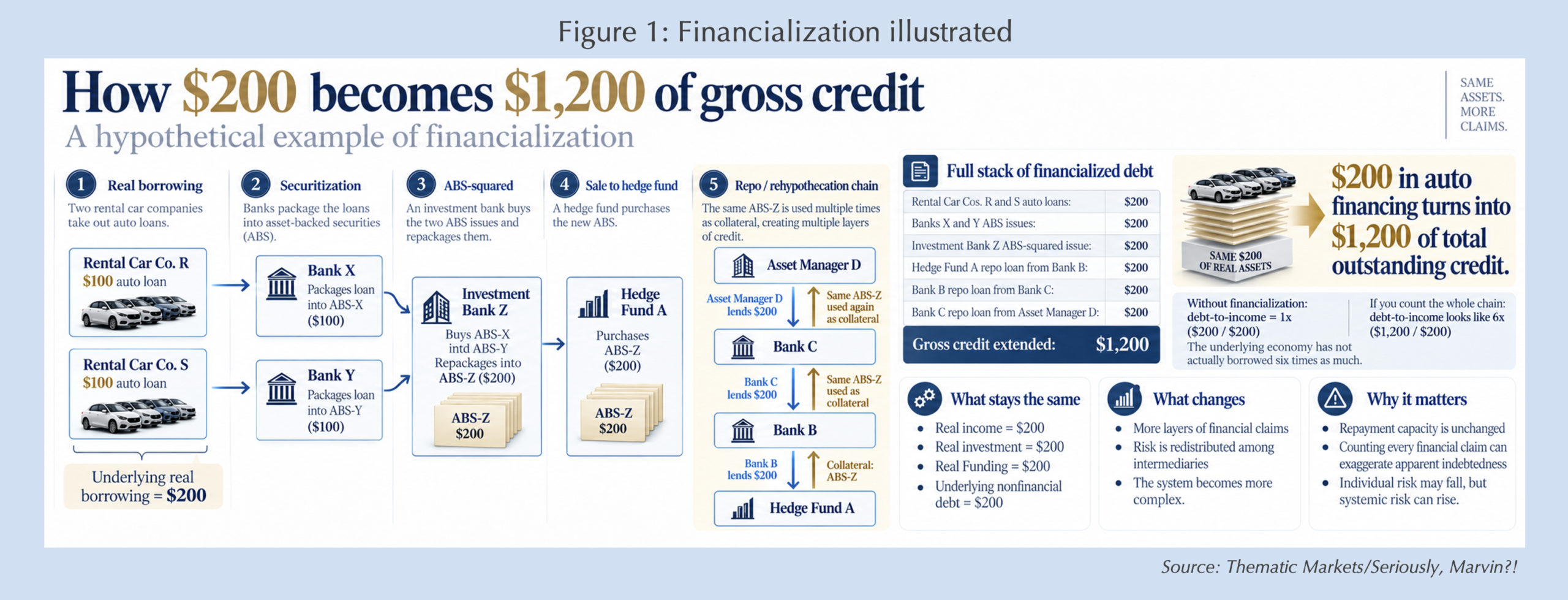
To illustrate how complex financialization can get and its consequences, let’s walk through a hypothetical example (Figure 1). Suppose that Rental Car Co. R and Rental Car Co. S each want to expand but need financing to fund the purchases of new cars for their respective fleets. R borrows $100 from Bank X and S borrows $100 from Bank Y. Banks X and Y each repackage their loans as ABS-X and ABS-Y, respectively. Investment Bank Z buys both ABS issues in full and repackages their payment streams as $200 of ABS-Z. Hedge Fund A purchases the $200 of ABS-Z, but needs a loan to finance it. Bank B loans A the $200, taking ABS-Z as collateral (a repo loan). But Bank B is short of cash that day, so it borrows the $200 from Bank C, using the ABS-Z securities as collateral in another repo. Bank C is in a similar position, so it borrows the $200 from Asset Manager D, again securing the loan with the ABS-Z securities. Let’s add up the full stack of financialized debt in this example:3[3]
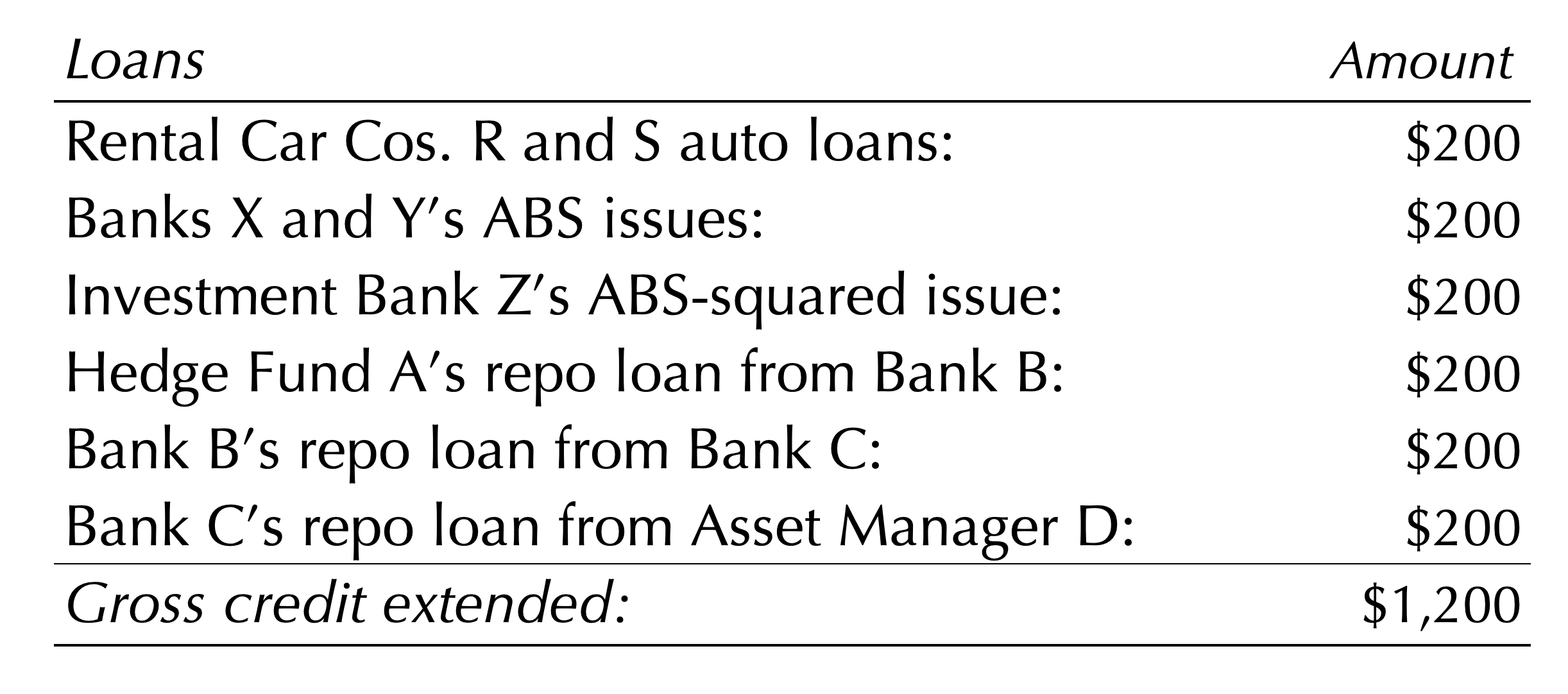
So, $200 in auto financing turned into $1,200 in total outstanding credit!
Misplaced fears
That sounds scary, and is, but not in the way many people think. Recall from my last piece that debt repayment capacity (and thus risk) is a function of the real income of the borrower. Suppose in the example above that Rental Car Cos. R and S have a joint income of $200 per year from renting cars. In a world without financialization, where they borrowed the money from Banks X and Y, without securitization or repo, the ratio of debt to income was 1 ($200/$200). But in the complex financialization example above, debt to income jumped to 6 ($1,200/$200)! Surely repayment risk has skyrocketed, no?
Nonfinancial claims versus financial claims
In reality, repayment capacity is unchanged. The income of this “economy” remains $200, the investment in real assets (new cars) remains $200, and the savings provided to finance it (coming from Asset Manager D) also remains $200. The chains of financial claims in between R and S’s loan and Asset Manager D’s savings are merely a reshuffling of risks among financial intermediaries.4[4] This is the critical point missed by many regarding financialization: nothing real in the economy has changed. At the national economy level, savings, investment, income, debt capacity, and its usage are unchanged. The debts of financial intermediaries, however extensive, are just passthrough claims from savers to the ultimate (real) borrowers. This is why serious analysis of an economy’s debt capacity focuses on the debt of nonfinancial entities (firms, households and governments) and excludes financial claims.
Financialization’s paradox of risk
That isn’t to say financialization is inconsequential or riskless. Indeed, much of the confusion about financialization stems from its endemic paradox: while financialization reduces the risk of any single creditor, it increases systemic risk. An individual buyer of a securitized product benefits from the diversification of risk provided by the pool of loans backing it; similarly, a lender receiving a security as collateral lowers the risk of the loan. But the sharing of risk that makes each individual credit less risky makes the system as a whole more fragile by propagating any defaults through the system. Without financialization, Banks X and Y bore the entire risk of default by Rental Car Cos. R and S; with financialization, Z, A, B, C, and D are now exposed to any default.
Magnifying real problems
Many blame the Global Financial Crisis (GFC) on financialization. That isn’t correct. But financialization did make the GFC worse. As with the Great Depression, the Banking Crisis of 1907, the South Seas Bubble, and the infamous Dutch Tulip Bubble — all of which occurred without financialization — the ultimate cause of the GFC was a negative income shock (a surge in gasoline prices) amid an asset price bubble that led to a deterioration in lending standards. When gasoline prices doubled, extended homeowners with even more extended commutes could no longer make their mortgage payments and defaulted. That’s why defaults were concentrated in a handful of exurbs nationally. But widespread financialization compounded problems by both spreading and obscuring exposure to mortgage defaults. After several layers of mortgage securitization were further obscured by daisy chains of rehypothecation through collateralized lending, it was impossible to know who held what risk. No one could trust that their counterparties were solvent so the whole financial system shut down.
Collateral damage
Financialization can also cause problems even without default. In the hypothetical example above, suppose that Bank B has a systems failure that prevents it from repaying Bank C. Since Bank C isn’t repaid it keeps the ABS-Z securities, meaning that Hedge Fund A can’t get its collateral back. Both Bank C’s shortage of cash and Hedge Fund A’s inability to receive its collateral can have knock-on effects throughout the financial system. This can happen even without problems at any of the financial intermediaries. During the initial market panic over Covid, risk aversion led many market participants to hoard safe US Treasury securities, collapsing the supply of collateral in the system. That made new repo borrowing nearly impossible and even disrupted existing repo lending when counterparties simply “failed to deliver” promised securities that were in short supply.
Causing asset bubbles?
But some posit that it was financialization itself that led to the housing bubble behind the GFC and worry that may be driving asset prices — particularly stock values — today. Even though financialization doesn’t increase available savings to fund investment (or boost asset values), there is a channel through which it may increase the share of savings devoted to credit finance rather than equity finance. Because financialization makes individual lenders feel more secure, it lowers the cost (interest rate) for borrowers. The borrowers thus may more readily seek debt financing instead of equity financing as a result. Hence, even though neither total savings nor investment have changed, the financing of the latter (and holdings of the former) may shift to rely more on debt than equity. In theory, that could boost the price of equities both due to lower discount rates and reduced dilution of earnings. (Note, that is different from a bubble since it is a fundamental rise in the value of stocks, but perhaps could start the inflation of a bubble.)
It ain’t in the data
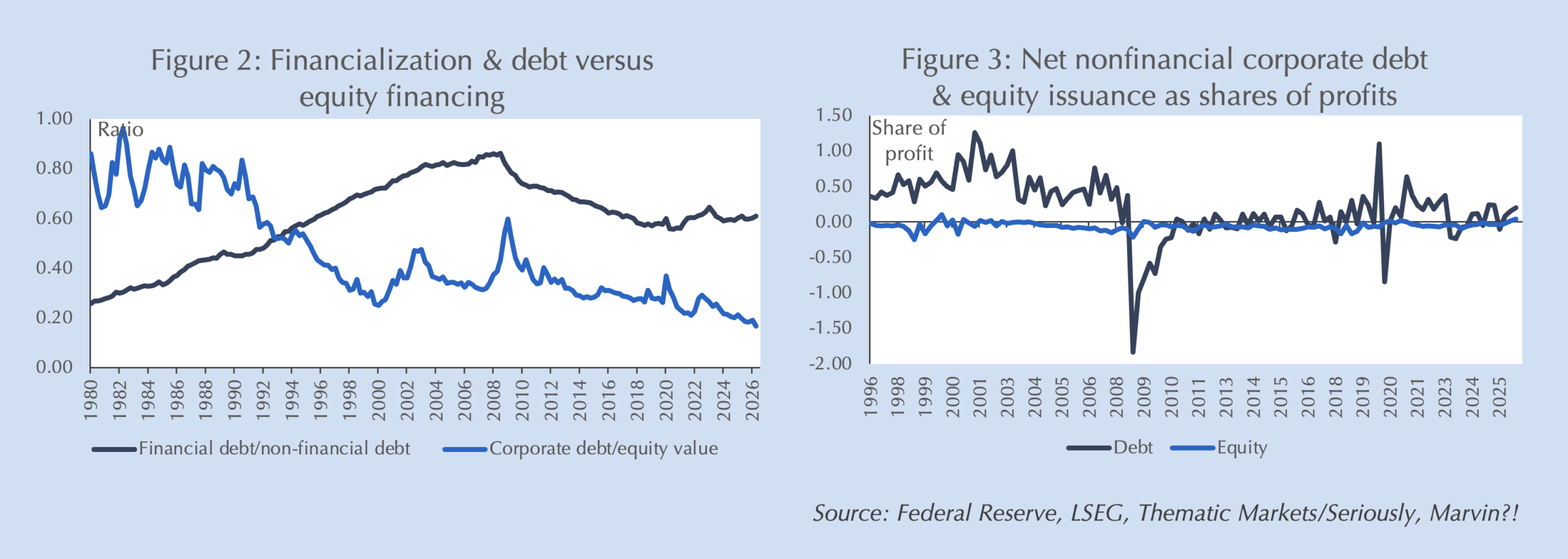
Yet the evidence for this contention is at best mixed. The dark line in Figure 2 shows the ratio of US financial debt — financial claims on other financial claims — to nonfinancial debt. This is a useful measure of financialization and illustrates its scale in the US economy. You can breath a sign of relief that rather than expanding nonfinancial debts by six times as in my hypothetical example, financial debt in the US peaked at 86% of private nonfinancial debt and has fallen to about 61% today. But note that as financialization tripled from 1980 to 2008, the ratio of debt to equity in corporate America fell (the blue line). Nominal debt did rise, but rising earnings pushed equity values up even faster, effectively delevering firms in the process.
“Rebalancing” leverage
Indeed, the rise in fundamental equity values was so great— and over fifty years, I think we can call it fundamental rather than the bubble some contend — that firms have had to continuously re-lever to slow the trend of deleveraging. Just as a balanced investor needs to continuously sell stocks and buy more bonds to rebalance their portfolio in a rising equity market, corporate America has continuously “rebalanced” towards a desired debt share of financing by issuing debt to retire equity, as shown in Figure 3 (thought the scale of equity buybacks as a share of gross profits is so small it is hard to see). That this was true both during three decades of increasing financialization leading to the GFC and in the decade of de-financialization that followed it suggests this was more due to corporate financing preferences rather than financialization.
Lessons for today
The lessons I take from this for current markets is that worries about financialization driving asset values are overblown. First, financializaiton is significantly lower today than it was heading into the GFC. Second, the debt-to-equity ratio has continued to fall, testifying that it is earnings, not releveraging that is driving equity values. Third, unlike in the lead-up to the GFC, or even the Dot.com bubble, corporate American has turned to issuing both equity and debt recently. That simultaneously testifies to the powerful Localization-driven capex boom propelling US economic growth and to the fundamental, rather than financial, underpinnings of US asset prices.










Comments are available to paid subscribers only.